RE
Overview
RE is an essential curriculum subject. It is important in its own right and also makes a unique contribution to the spiritual, moral, social and cultural development of children. In reflection of this, we aim to develop individual’s knowledge and understanding of the religions and beliefs which form part of our contemporary society. Through developing children’s knowledge and understanding we can promote mutual respect and tolerance in our diverse community.
Why do we teach RE at Coleridge Primary School?
RE subject matter gives particular opportunities to promote an ethos of respect for others, challenge stereotypes and build understanding of other cultures and beliefs. This contributes to promoting a positive and inclusive school ethos that champions democratic values and human rights.
In summary, religious education for children and young people:
provokes challenging questions about the meaning and purpose of life, beliefs, the self, issues of right and wrong, and what it means to be human. It develops pupils’ knowledge and understanding of Christianity, other principal religions, and religious traditions that examine these questions, fostering personal reflection and spiritual development encourages pupils to explore their own beliefs (whether they are religious or non-religious), in the light of what they learn, as they examine issues of religious belief and faith and how these impact on personal, institutional and social ethics; and to express their responses. This also builds resilience to anti-democratic or extremist narratives
enables pupils to build their sense of identity and belonging, which helps them flourish within their communities and as citizens in a diverse society teaches pupils to develop respect for others, including people with different faiths and beliefs, and helps to challenge prejudice
prompts pupils to consider their responsibilities to themselves and to others, and to explore how they might contribute to their communities and to wider society. It encourages empathy, generosity and compassion.
What do we cover at Coleridge Primary School?
All teaching staff at Coleridge Primary School ensure that all pupils are offered a high quality, coherent and progressive experience of RE.
EYFS
Christianity, religions and beliefs represented in our class or school.
In our Early Years Foundation Stage, Pupils encounter religions and world views through special people, books, times, places and objects and by visiting places of worship. They listen to and talk about stories. They are introduced to subject specific words and use all their senses to explore beliefs, practices and forms of expression. They ask questions and reflect on their own feelings and experiences. They use their imagination and curiosity to develop their appreciation of and wonder at the world in which they live. Religious Education is, unlike the subjects of the National Curriculum, a legal requirement for all pupils on the school roll, including all those in the reception year.
KS1
Judaism and Christianity
The Focus of RE for KS1 enables our children to develop their knowledge and understanding of religions and world views. They find out about simple examples of religion that are drawn from local, national and global contexts. They learn to use basic subject specific vocabulary. They raise questions and begin to express their own views in response to the material they learn about and in response to questions about their ideas.
KS2
Islam, Hinduism, Christianity, Buddhism and Sikhism.
The Focus of RE for KS2 enables pupils to extend their knowledge and understanding of religions and world views, recognising their local, national and global contexts. They are introduced to an extended range of sources and subject specific vocabulary. They are encouraged to be curious and to ask increasingly challenging questions about religion, belief, values and human life. All pupils learn to express their own ideas in response to the material they engage with, identifying relevant information, selecting examples and giving reasons to support their ideas and views.
Celebrations in School
Throughout school we are conscious that it is appropriate to celebrate a wide range of religious festivals. We therefore ensure that we have a broad coverage of religious events such as Diwali, Harvest Festival and Eid. We ensure that these celebrations are carried out alongside the local community and parents/carers are actively encouraged to participate in these events to create real cohesion within our community.
Local Visits
We have several strong links with the local Pastor at Hope Church and Imam at Russell Street Mosque. Both deliver assemblies within school every half-term focusing on different aspects of their religion. We also go on annual visits to the church at Christmas and Easter and to the Mosque in Ramadan on the run-up to Eid. We also have links with a local synagogue and the Rabbi has started to deliver assemblies with our children looking at the Jewish faith.
Guidance
Religious Education (RE) must be taught by all state-funded schools in England. However, it has an unusual position on the curriculum: it is part of the basic curriculum but not the National Curriculum, and is one of two subjects (along with sex and relationship education) where parents have a legal right to withdraw their children from class.
At Coleridge Community Primary School, we follow SACRE, the agreed syllabus for Rotherham. Children are taught to understand and respect the importance of religious beliefs in the world around them. We aim to ensure that the RE curriculum is challenging, dynamic and relevant to pupils of all ages.
Intent, Implementation and Impact
Statement of Intent
Our vision for Religious Education is that we provide every child with high quality experiences which engage and inspire them to explore their own personal experiences and experiences which differ from their own. We aim for every child to leave Coleridge Primary School with an understanding, acceptance and respect for all families in our community and wider world.
At Coleridge Primary School, our programme of work ensures that children have a broad and well mapped out RE curriculum. It provides the opportunity for progression across the full breadth of a wide variety of beliefs and cultures for all children from EYFS through to the end of KS2.
Implementation
At Coleridge Primary School, we encourage children to explore a variety of religious experiences through which we aim to build up the confidence of all children.
Our detailed units of work ensure that all teachers are equipped with the secure subject knowledge required to deliver high-quality teaching and learning opportunities for all areas of the Religious Education curriculum. Our overarching aim is for teachers to have the knowledge and skills they need to feel confident in teaching all areas of Religious Education, regardless of their main areas of expertise.
There is a structure to the lesson sequence whereby prior learning is always considered and opportunities for revision and practise are built into lessons. However, this is not to say that this structure should be followed rigidly: it allows for this revision to become part of good practice and ultimately helps build depth to the children’s knowledge, skills and understanding in the views and beliefs of others. We strongly encourage children to draw on their own personal experiences and encourage children to share these with their peers.
Impact
Children will:
- Describe, explain and analyse beliefs and practices, recognising the diversity which exists within and between communities
- Identify, investigate and respond to questions posed by, and responses offered by some of the sources of wisdom found in religions and world views
- Appreciate and appraise the significance and impact of different ways of life and ways of expressing meaning
- explain reasonably their ideas about how beliefs, practices and forms of expression influence individuals and communities
- express their personal reflections and critical responses to questions and teachings about identity, diversity, meaning and value
- appreciate and appraise varied dimensions of religion
- find out about and investigate key concepts and questions of belonging, meaning, purpose and truth, responding creatively
- enquire into what enables different communities to live together respectfully
- articulate beliefs, values and commitments clearly in order to explain reasons why they may be important in their own and other peoples lives.
Curriculum Map
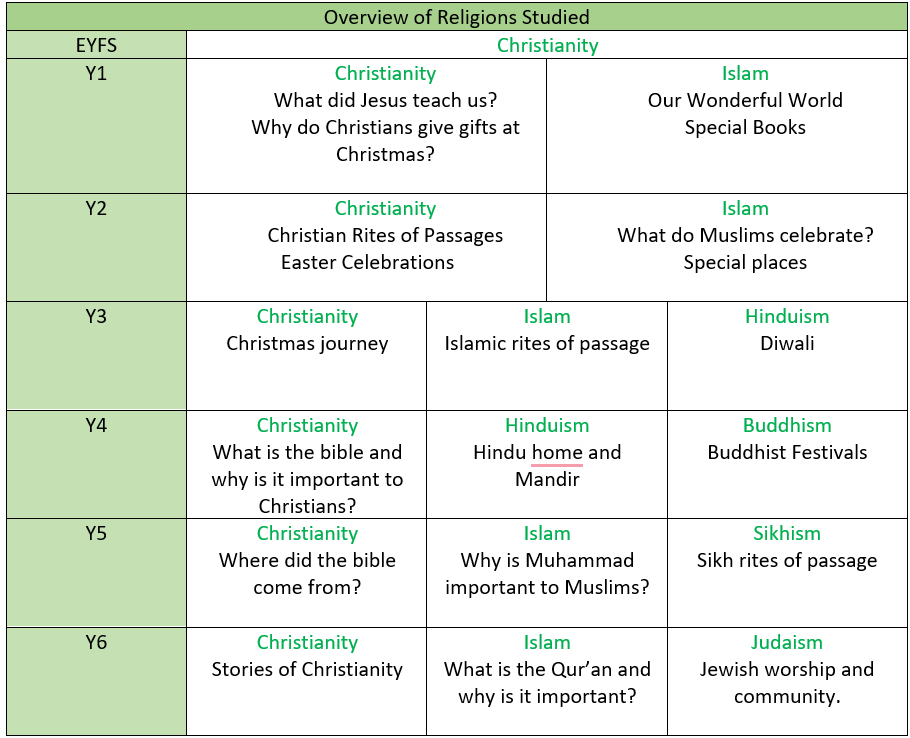
Progress Models
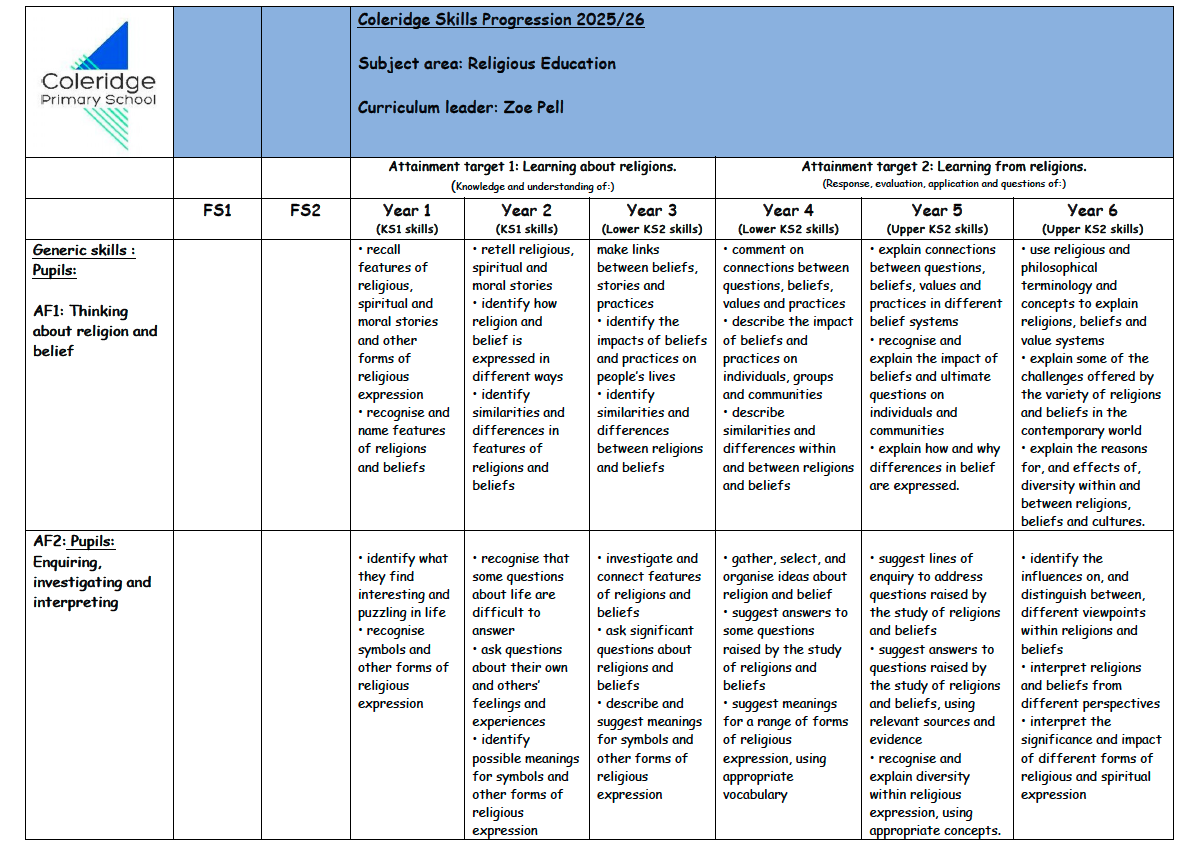
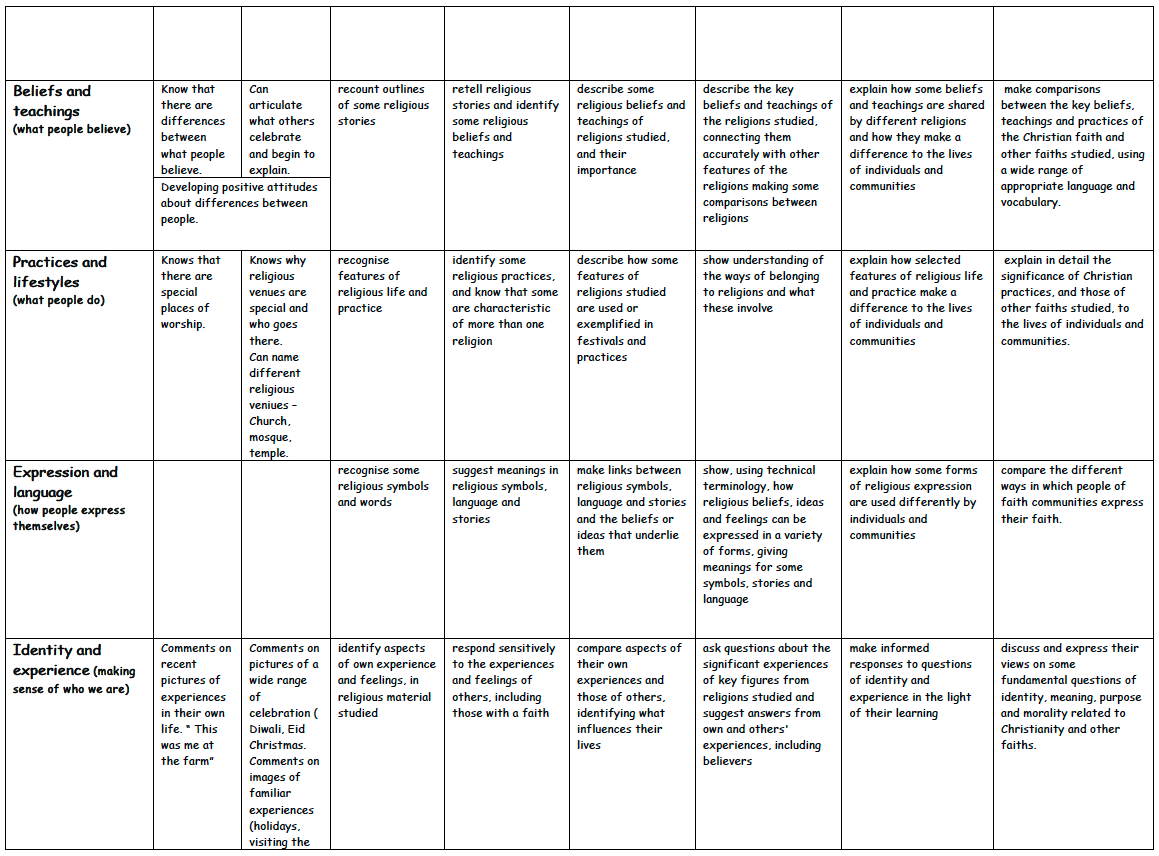
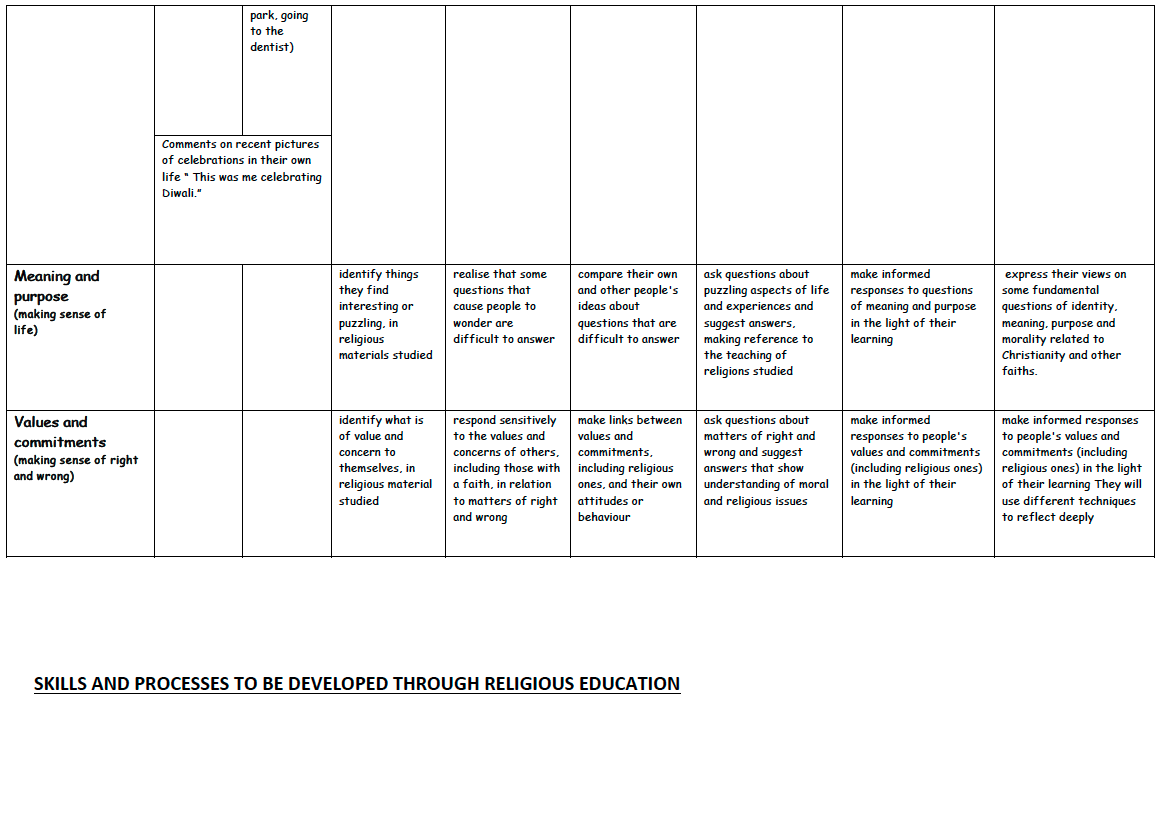
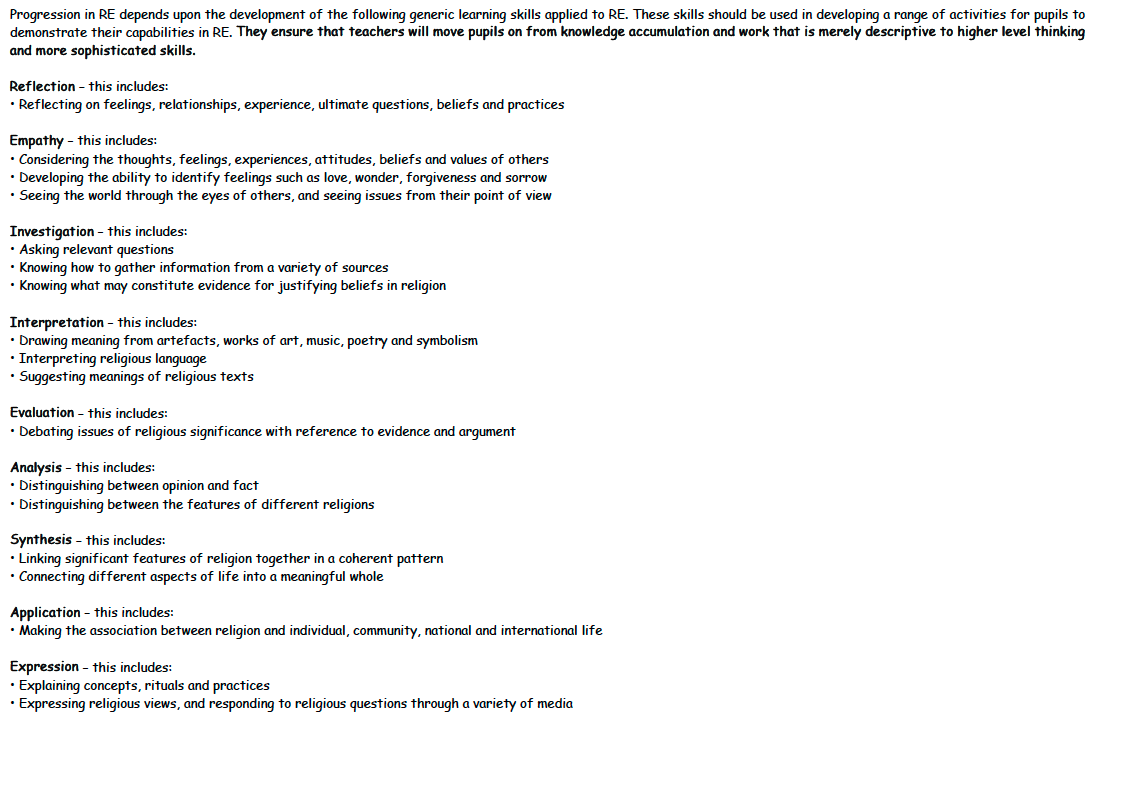
Progression of Language
Religious Education Progression of language.
The table below shows the vocabulary each year group will focus on. The language is built up and revisited over time, so vocabulary is not exclusive to only one year group. Each year teachers will review and revisit previously taught vocabulary to ensure specific language and definitions are embedded. The definitions ensure consistency through year groups across school.
Year 1 | ||
| Christianity | Jesus | The son of god. |
| God | A person who created the heavens and the earth. | |
| Mary | Mother of Jesus. | |
| Angel | An agent of god. | |
| Bethlehem | A town. | |
| Disciples | Followers of Jesus. | |
| Miracle | A remarkable event. | |
| Sermon | A lecture by a preacher. | |
| Parable | A short story that teaches a moral. | |
| Islam | Creation | Muslims believe that Allah is responsible for the creation of the universe. |
| Heaven | A common religious supernatural place | |
| Muslim | People who practice Islam | |
| Torah | The Holy Jewish book | |
| Qur’an | The Islam holy book | |
| Bible | The Christian Holy book. | |
Year 2 | ||
| Christianity | Celebration | A time of special importance. |
| Rite of passage | A celebration. | |
| Baptism | A Christian celebration of birth. | |
| Marriage | A Christian partnership of love. | |
| Funeral | To pray for the soul of the deceased. | |
| Holy communion | A celebration which takes place during Passover. | |
| Easter | A celebration to mark the resurrection of Jesus. | |
| Prey | To speak to a god. | |
| Cross | The symbol of the crucifixion of Jesus Christ. | |
| Heaven | A place where the people of god live after death. | |
| Islam | Islamic new year | |
| Day of Ashura | A holy day for Muslims. | |
| Mawlid al-Nabi | ||
| Mosque | A place of worship. | |
| Hafiz | A person who memorises and recites the Qur’an. | |
| Islam | A religion. | |
| Muslim | Followers of Islam. | |
| God | Allah is the god of Islam. | |
| Alah | The God of Islam. | |
| Temple | A place of worship. | |
| Mosque | A place of worship. | |
| Qur’an | Holy book of Islam. | |
Year 3 | ||
| Christianity | Bethlehem | – A town. |
| Pilgrimage | – A journey. | |
| Nativity | – Explains the story of Jesus. | |
| Mary & Joseph | – Key people in the Christian Christmas story. | |
| Nazareth | – A city in Israel. | |
| Herod | – The name of a king. | |
| Hinduism | Diwali | A festival of light. |
| Rama and Sita | Key people in a famous Hindu story. | |
| Ravana | A king of the island Lanka. | |
| Hanuman | A Hindu god. | |
| Lakshmi | A popular goddess. | |
| Divas | An annual celebration. | |
| Rangoli | A traditional art form. | |
| Islam | Five pillars | Five key practices that Muslims are obliged to fulfil. |
| Salat,Shahadah, Zakat, Sawn, Hajj | Names of the five pillars. | |
| Allah | The god of Muslims. | |
| Pilgrimage | A journey. | |
| Ramadan | A month of fasting. | |
| Mosque | Islam place of worship. | |
| Tasmiyah/Basmalah | A traditional prayer. | |
| Adhan | The Islamic call to prayer. | |
| The mahr | A contract some Muslims enter into upon marriage. | |
| The mikah | A ceremony for a Muslim couple to be legally wed under Islamic law. | |
| The walima | The marriage banquet. | |
| Mangni ceremony | An engagement in anticipation of a future Mikah. | |
| Salatul Janazah | The Islamic funeral prayer. | |
| fatihah | The First chapter of the Qur’an. | |
Year 4 | ||
| Christianity | Bible | Christian holy book. |
| Mary Jones | Key person in a bible story. | |
| Preist | A minister | |
| Church | Christian place of worship. | |
| Adam & Eve | A famous bible story. | |
| Noah’s Ark | A famous bible story. | |
| Old testament | First part of the bible. | |
| New testament | Second part of the bible. | |
| Buddhism | Festival | A celebration. |
| Buddha | One who has attained wisdom. | |
| Siddhartha Gautama | The founder of Buddhism. | |
| Temple | place of worship. | |
| Meditate | focus the mind in silence or chanting. | |
| Reincarnate | Reborn in another body. | |
| Ying Yang | The balance between two opposites. | |
| Vasak | A traditional Buddhist festival. | |
| Dharma Wheel | A symbol | |
| The ploughing festival | A traditional Buddhist festival. | |
| Loy Krathong | An annual festival. | |
| Songkran | A celebration to mark the start of the Buddhist New Year. | |
| Nirvana | The goal of the Buddhist path. | |
| Parinirvana | Commonly used to refer to nirvana-after-death. | |
| Hinduism | Aum symbol | This symbolises the universe and the ultimate reality. |
| Brahma | One of the major gods of Hindism. | |
| Saraswati | The wife of the great God Brahma. | |
| Neasden temple | A Hindu temple in London. | |
| Vishnu | One of the principle Hindu deities. | |
| Lakshmi | The wife of Vishnu. | |
| Shiva | One of the principle Hindu deities. | |
| Ganesha | The elephant-headed Hindu god of beginnings. | |
| Shrine | A small area where Hindus can worship daily. | |
| Mandir | A symbolic house designed to bring humans and gods together. | |
| Murti | A general term for an image, statue or idol of deity or mortal in Hindu. | |
| Prasad | Food and water offered to a deity during worship. | |
| Puja | Ceremonial worship. | |
Year 5 | ||
| Christianity | Bible | Christian holy book. |
| Old testament | First part of the bible. | |
| New testament | Second part of the bible. | |
| The book of Psalms | Provides instructions and songs. | |
| The Gospels | Stories told about Jesus. | |
| Genesis | A famous bible story. | |
| Adam & Eve | A famous Bible story. | |
| Garden of Eden | Where Adam & Eve lived. | |
| Islam | Mecca | Town where Muhammad was born. |
| Medina | The capital city. | |
| Khadijaah | Muhammad’s wife. | |
| Qur’an | Holy book of Islam | |
| Prophet | A person who shares Allah’s messages. | |
| Persecuted | Subjected to hostility or ill treatment. | |
| Ramadan | A time of spiritual reflection. | |
| Sikhism | Reincarnation | A person dies; their soul is born again. |
| Guru Granth Sahib – | Sikh holy book. | |
| Antam Ardas – | Final prayer. | |
| Gurdwara | Sikh place of worship. | |
| Khanda | The symbol of the Sikh faith. | |
| Guru Narak | The founder of Sikhism. | |
| The Kirpin | a small dagger/sword. | |
| The Kaccha | A loose under garment. | |
| The Kanga | A small comb. | |
| The Kara | A metal bracelet. | |
| The Kesh | Hair. | |
| Antam Sanskar | Sikh funeral. | |
| Amrit | Sikh baptism. | |
| Anand Karaj | Sikh wedding. | |
| Mool Mantra | A passage from the Guru | |
Year 6 | ||
| Christianity | Noah’s arkJonah and the whaleJosephs coat
David and Goliath Ruth and Naomi The Exodus The birth of Jesus Feeding the five thousand The Easter story David and the lion’s den John the Baptist | Titles of famous bible stories |
| Old testament | First part of the bible. | |
| New testament | second part of the bible. | |
| Genesis | First book of the old testament | |
| Revelation | last book of the new testament. | |
| Islam | Qur’an | Holy book of Islam. |
| Sacred | Something that is sacred is holy. | |
| Rihal | Special stand where the Qur’an is stored. | |
| Compassionate | Feel or shows pity, sympathy and understanding. | |
| Merciful | Shows kindness and forgiveness. | |
| Madrasah | A school at the Mosque | |
| Judaism | Abraham | The founder of Judaism |
| Torah | The Jewish holy book. | |
| Synagogue or temple | Jewish place of worship. | |
| Hebrew | The language which the Torah is written inn. | |
| Siddur | Jewish prayer book. | |
| Shabbat | A day for families to spend time together and relax. | |
| Kippah | Small cap to cover the head. | |
| Tallit | A traditional shawl. | |
| Tzitzit | Tassels on the tallit. | |
| Tefillin | Small box containing passages from the Torah. | |
| Shema | A special prayer. | |
| Brit Milah | Birth ceremony for boys. | |
| Bar Mitzvah | Son of commandments. | |
| Drar Torah | A speech made at the Bar Mitzvah ceremony. | |
| Tzedakah | A term used for charity. | |
| Rabbi | Jewish spiritual leader or teacher. | |
| Cantor/chazzan | A person who leads the congregation. | |
| Yad | A pointer used to touch the Torah. | |
Knowledge Organisers
At Coleridge we understand the importance of knowledge organisers and how they can support children’s understanding and learning.
They are also an excellent assessment tool which can help identify gaps in learning and inform planning, teaching and intervention. As we have developed our own curriculum, class teachers have also developed knowledge organisers to work alongside our curriculum. Children will be encouraged to refer to knowledge organisers throughout sessions to help support and enhance their learning.
Knowledge organisers can be a valuable tool for both children, staff and parents. Class teachers are the ones who write the knowledge organiser, to set out their expectations of what pupils should learn about a topic – and to clarify their own thinking around what is important.
School leaders, headteachers and subject leaders then may look at a series of knowledge organisers to check for progression and continuity both within and across curriculum subjects and to ensure standards and expectations for learning are being implemented, and if not, what CPD is required.
Pupils will review, revise and quiz themselves using their knowledge organisers. Knowledge organisers are a really clear and easy to understand way for parents to be more aware of what their children are learning and thus to support them.
Some of the benefits of knowledge organisers
- A knowledge organiser makes the teacher think hard about what will be taught.
- Knowledge organisers are an endless source of meaningful homework activities.
- Knowledge organisers are an excellent tool for inclusion.
- Knowledge organisers create opportunities for spaced retrieval practice.
- Ahead of a summative assessment at the end of a topic you can inform pupils that some of the questions will refer to previous learning; pupils can then refer to the knowledge organiser to access and practice those topics.
- Used appropriately, knowledge organisers can increase retention of facts
At Coleridge, we have several non-negiotiables that need to be included in a knowledge organiser, they are:
- Key vocabulary (linked to Progression of language)
- Key places and people
- Useful diagrams (as required for the topic)
- Key dates for a subject like history (e.g. when the two World Wars were)
- Key themes
- Important quotes
- Stem sentences for a subject like Science or Maths
We use knowledge organisers throughout school, however, in EYFS they look different to other phases of school due to the away the curriculum is structure. In EYFS, we use a holistic approach to knowledge organisers and have a topic knowledge organiser, whereas, in KS1 and KS2 our knowledge organisers are subject specific.
If you would like any information about our knowledge organisers then please contact us
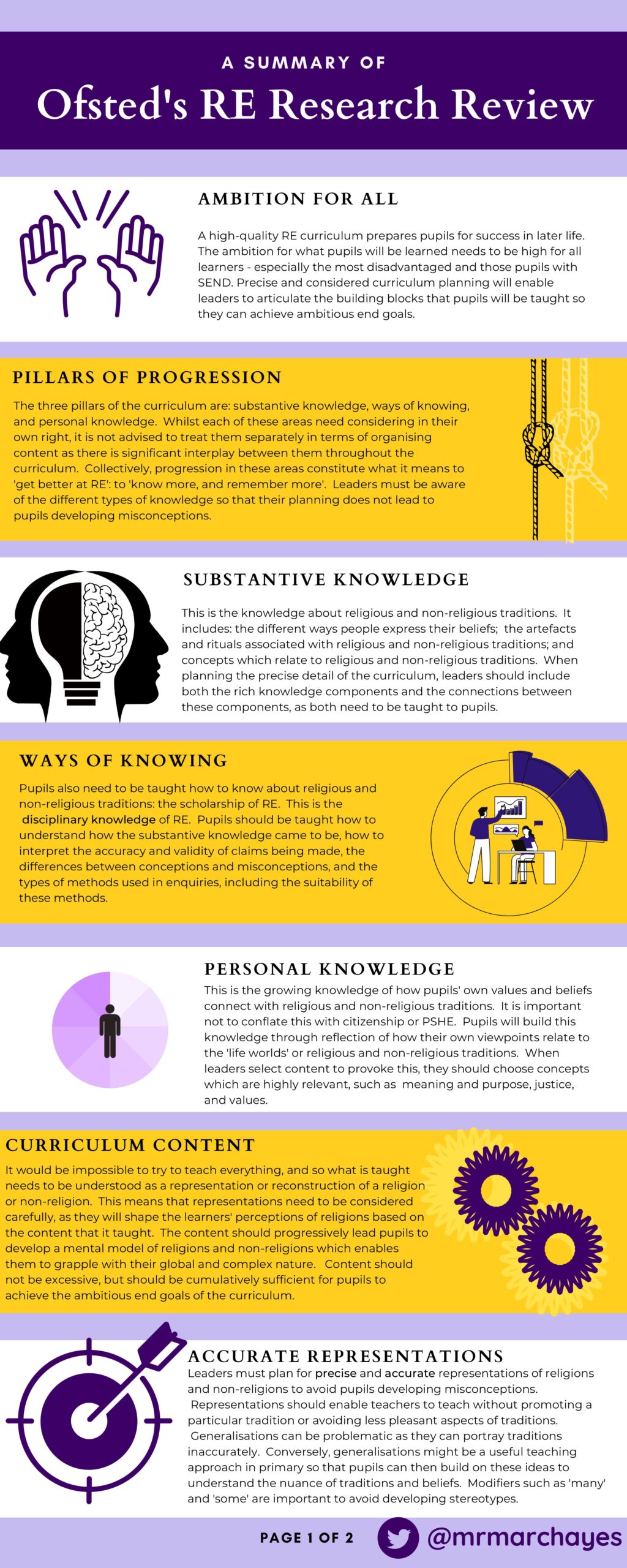
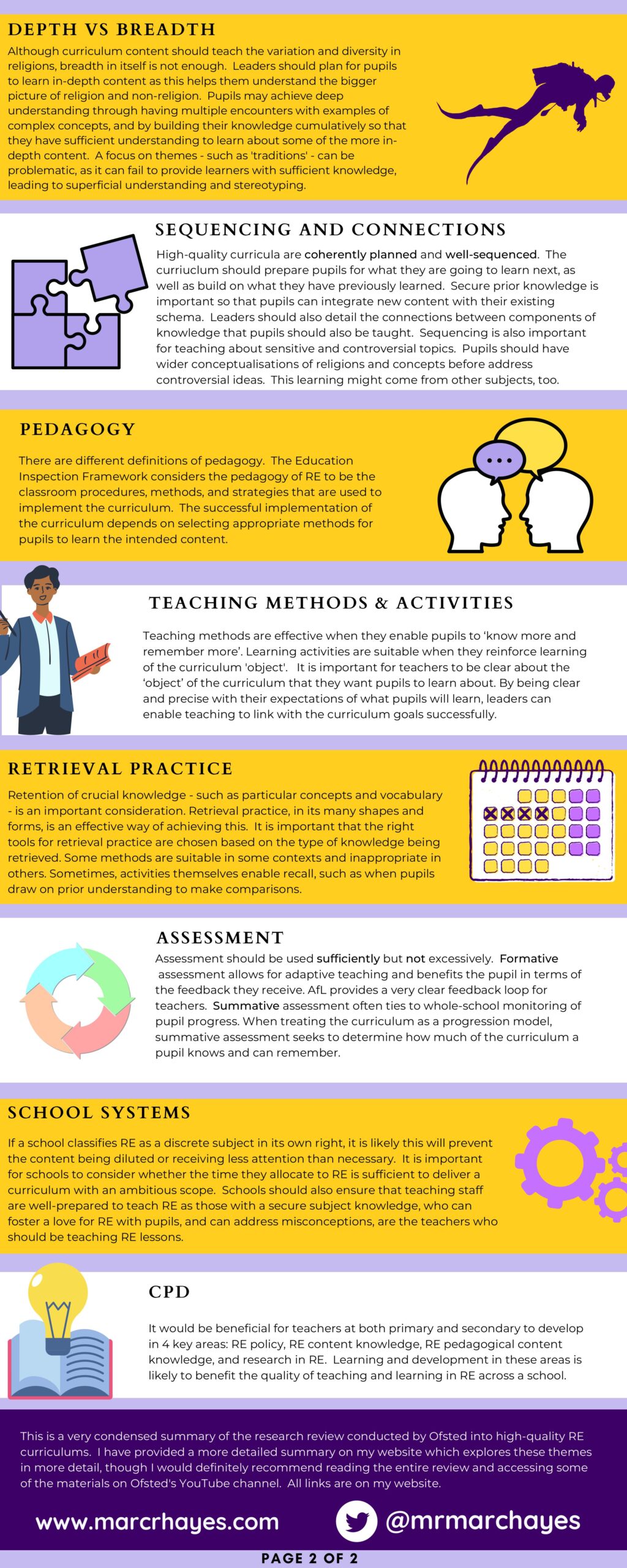
Research
Research around the curriculum
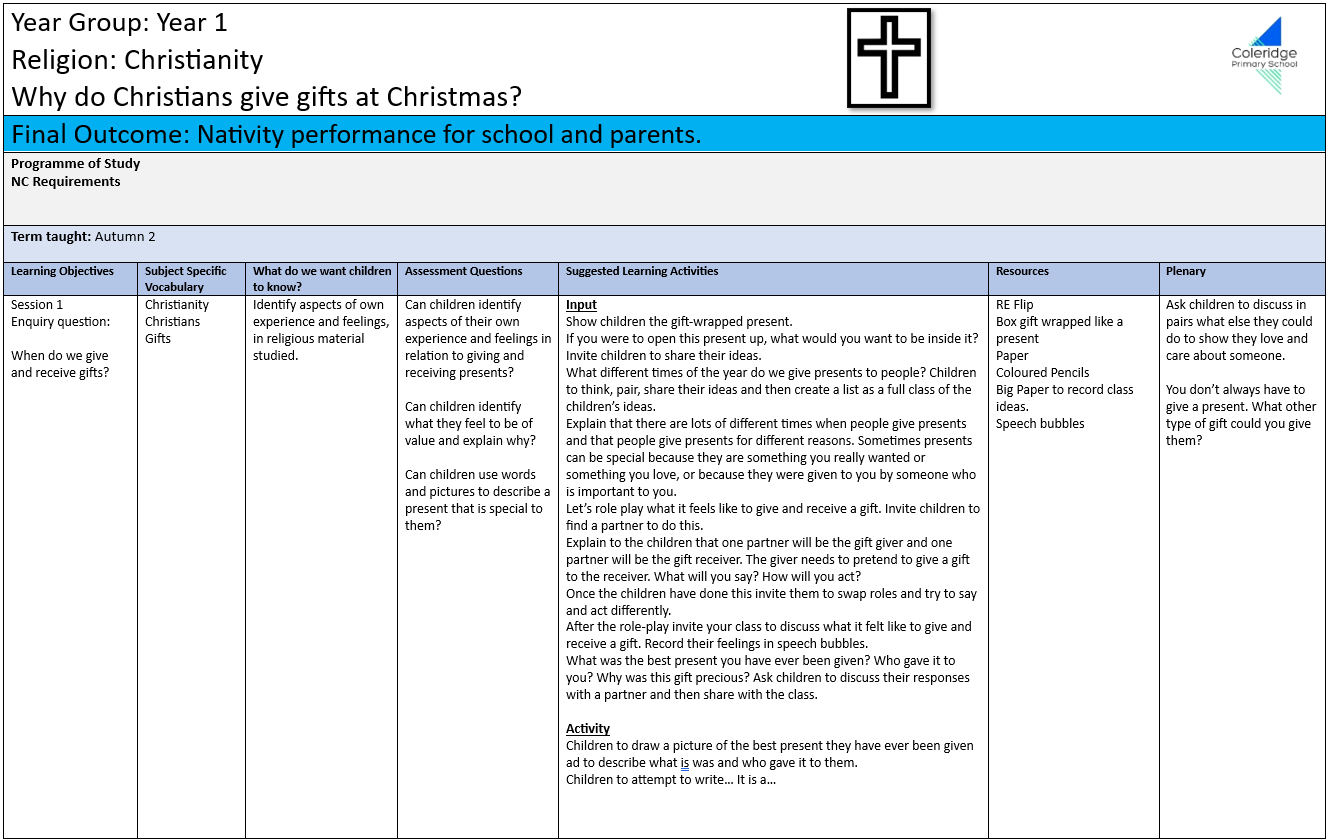
Examples of Planning
Please find examples of our medium term plans. These detail each lesson within in a planned sequence of sessions.
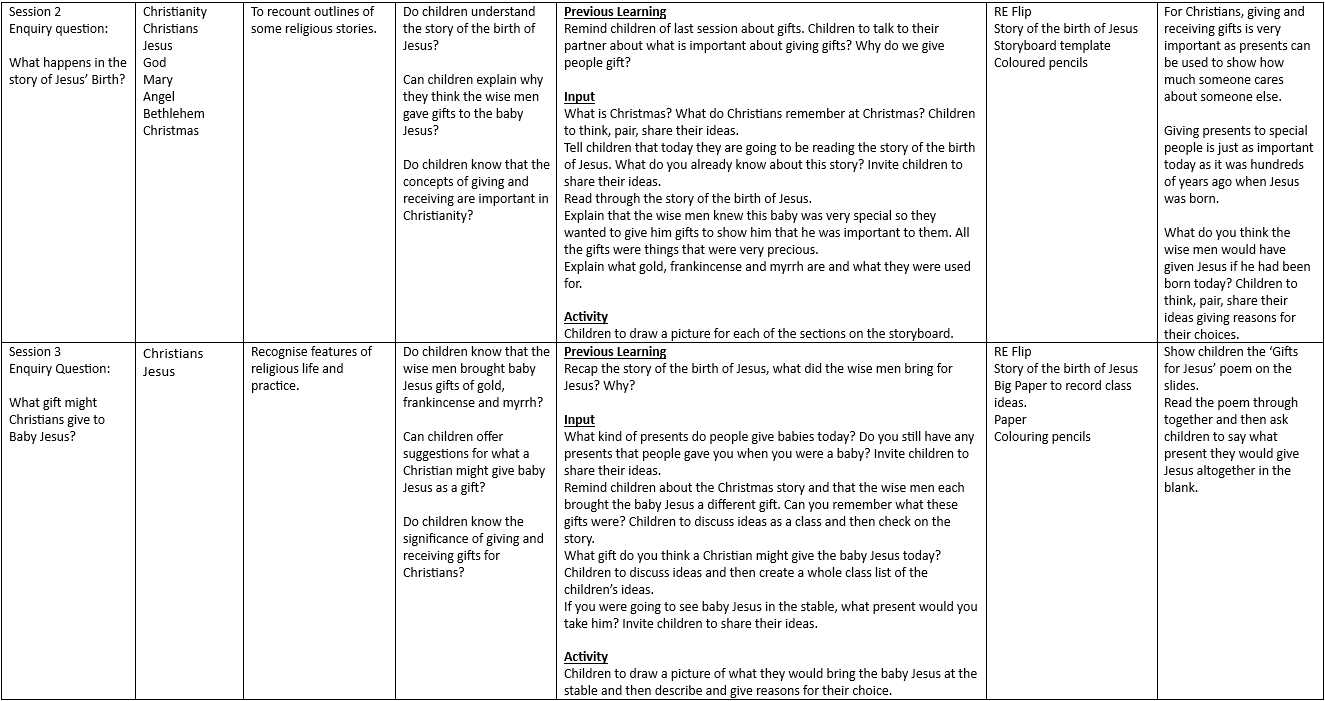
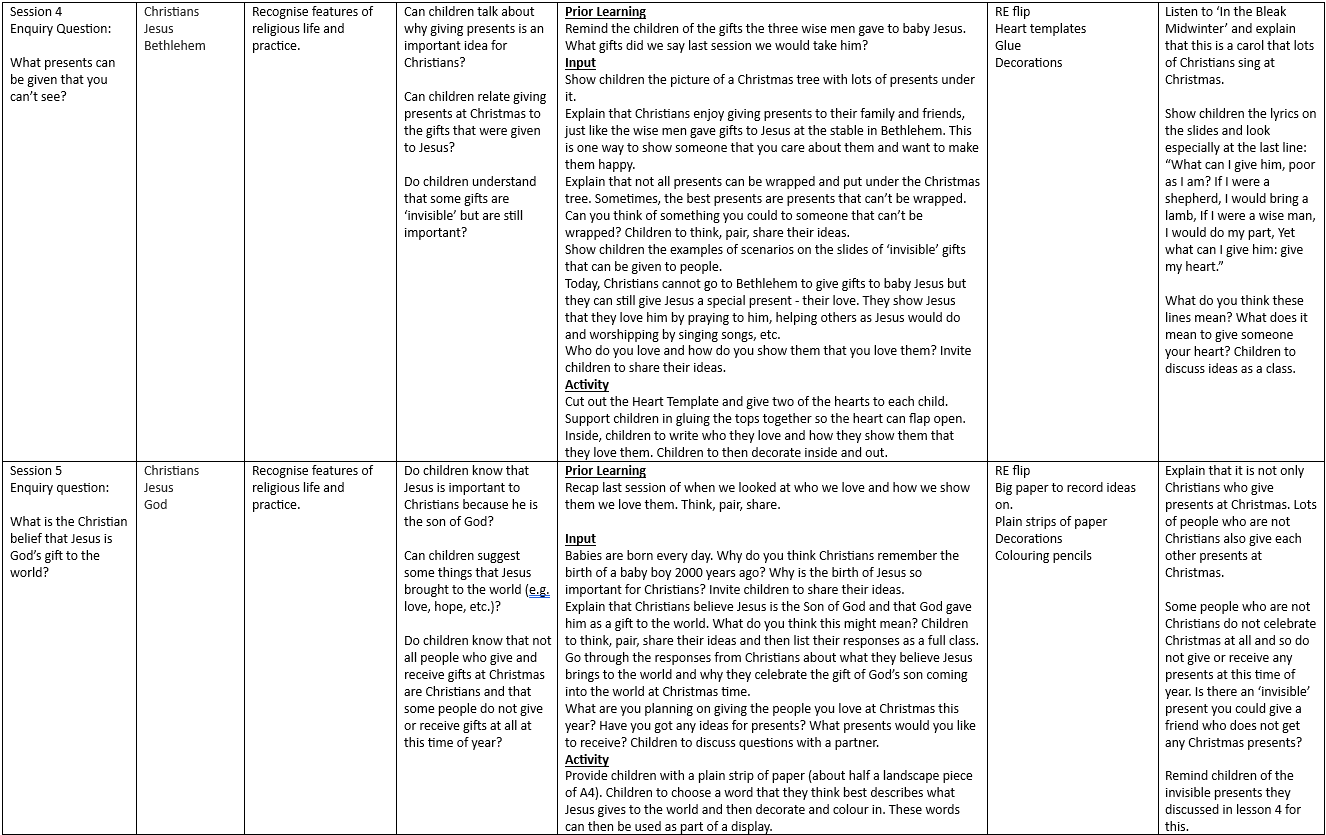
Y1 Why do Christians give gifts at Christmas?
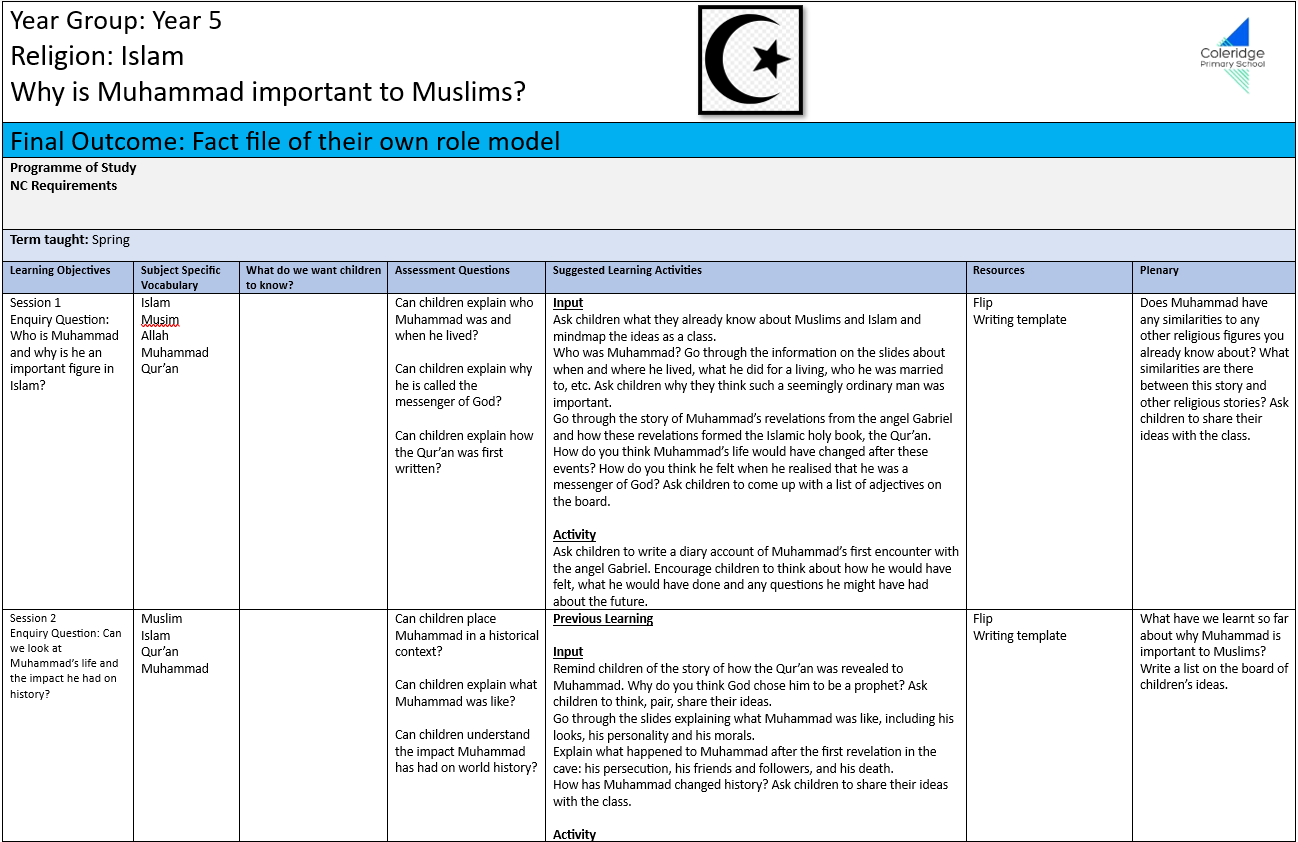
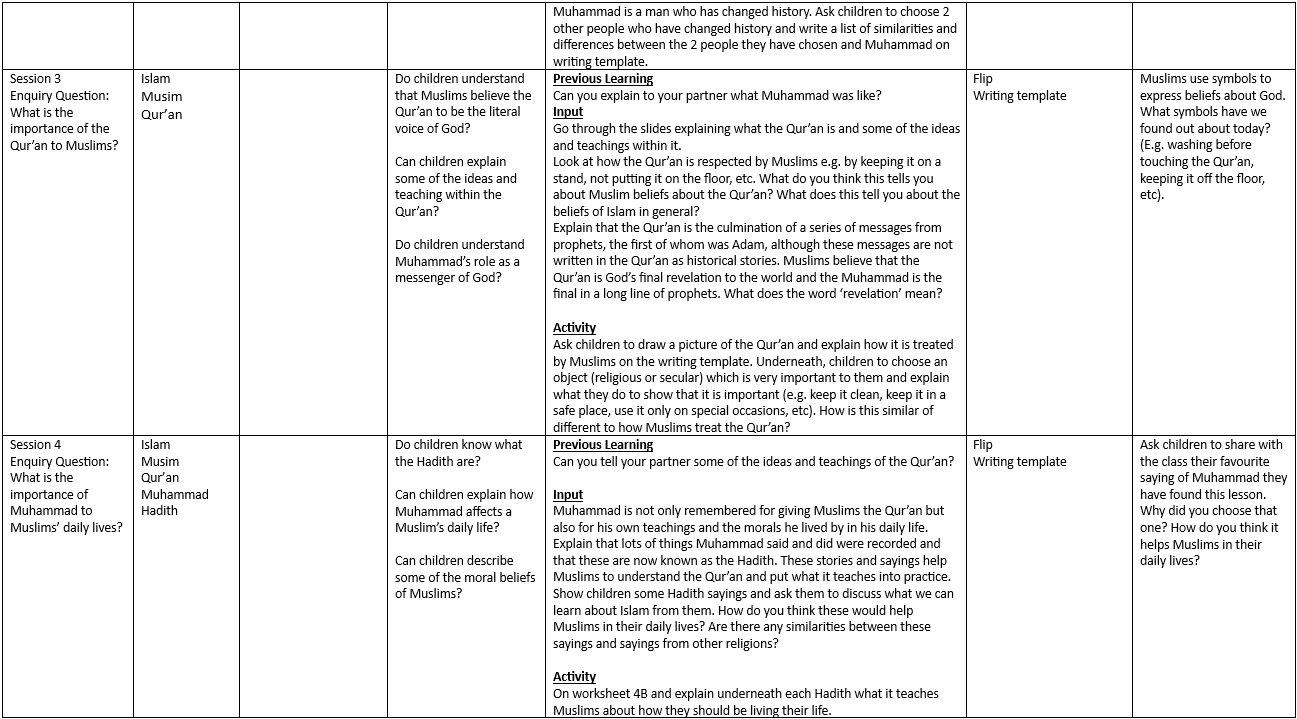
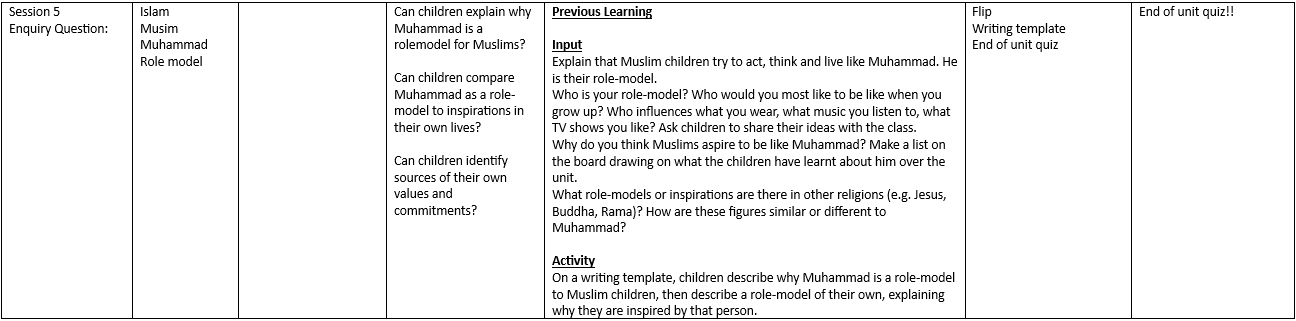
Year 5 Why is Muhammad important to Muslims?