
PE
Overview
At Coleridge Primary School we aim to equip all pupils with the skills and confidence to participate in life long physical activity to ensure a healthy lifestyle.
Our offer for PE and School Sports has been accredited with a School Games Mark Gold award for the latest academic year. We have a close working partnership with Live and Learn Sports to provide high-quality PE provision for all our children. A dedicated sports coach from the Live and Learn Sports team works in partnership with us to deliver specialist PE lessons across the school. Class teachers work alongside the coach to support all children within their groups, ensuring that lessons include appropriate challenge and scaffolding to meet the needs of every pupil. In addition to high-quality PE provision, Live and Learn Sports also provides valuable CPD opportunities for our staff, as well as breakfast clubs, after-school clubs and competitive sporting opportunities for our children.
The aims of the PE national curriculum are to ensure all children:
- Develop competence to excel in a broad range of physical activities
- Are physically active for sustained periods of time
- Engage in competitive sports and activities
- Lead healthy, active lives

PE Planning
Planning is based on assessment criteria for each year group to ensure a progression of skills in each area of the curriculum. Lessons are carefully planned to ensure the content is beneficial to the needs of our children at each age group. This is done to ensure a steady progression of skills to allow our children to become competent in a broad range of physical activities.
Structure
We structure our lessons by starting with an opportunity for our children to do warm up with dynamic & static stretches. We then focus on the learning of new skills and a chance for children to practice and progress these skills. The latter part of our lessons focus on game play and a chance for children to apply these new skills in a game situation to embed new learning. This can often be done through modified games. At the end of our lessons we do a plenary to give our children a chance to reflect on their learning and evaluate performance.
We strive to deliver outstanding provision for our children by ensuring that our lessons cover the four key strands of the PE national curriculum:
- Acquiring and developing skills
- Selecting and apply skills
- Evaluating and improving performance
- Knowledge and understanding of health and fitness
Questioning
Within our PE lessons, we aim to use effective questioning to consolidate and promote learning. We focus on asking open ended questions which give our children a chance to explain their answers in depth to support learning. Our staff and sport tutors aid this approach by using language structures to carefully phrase questions for children. We aim to use sentence starters and phrase questions carefully such as:
Can you describe what you did… Can you convince me that’s the right way… Explain how to perform this skill…
I know this because… Talk to me about this a bit more…
Assessment in PE
Working alongside our staff from Live and Learn Sports, we assess our children every half term on the sport they have been learning. Each sport has five statements in which a child can achieve throughout the unit of work. Each child will be given a level in accordance with how many statements they achieve.
- 1 statement- Entering
- 2-3 statements- Developing
- 4 statements- Secure
- 5 statements- GD
Alongside the level of achievement, each child will also receive an effort grade between 1 and 5 with 5 being excellent.
Competitive sport
At Coleridge, we offer our children the chance to engage in a wide range of competitive sport. As part of our close working relationship with Live and Learn Sports, our children have the opportunity to attend weekly competitions in a broad range of sports. On Mondays mornings, our sports teams from across schools attend weekly competitions organised by Live and Learn where they compete against other schools within our cluster. Furthermore, the winners of these events have the chance to progress to the Rotherham Schools Finals.
In addition to the competitions, our children also have the opportunity to attend weekly sporting fixtures. Each week on a Thursday, after school, selected children will play competitively against other schools at different sports. Over the course of the academic year, our children participate in basketball, netball, tag rugby, cricket and rounders fixtures. Here is another way that we ‘Engage children in competitive sport and activities’ as outlined in the aims of the PE national curriculum.
Inclusion and SEND
We have a commitment to ensuring all our children have access to high-quality PE provision. All children have the right to enjoy and succeed in a range of physical activities. Therefore, we ensure that we offer a range of approaches to out PE lessons to make sure every child has full participation. Our differing approaches are detailed below:

Aims
National Curriculum Aims
The national curriculum for physical education aims to ensure that all pupils:
- develop competence to excel in a broad range of physical activities
- are physically active for sustained periods of time
- engage in competitive sports and activities
- lead healthy, active lives
Subject content
Key stage 1
Pupils should develop fundamental movement skills, become increasingly competent and confident and access a broad range of opportunities to extend their agility, balance and coordination, individually and with others. They should be able to engage in competitive (both against self and against others) and co-operative physical activities, in a range of increasingly challenging situations.
Pupils should be taught to
- master basic movements including running, jumping, throwing and catching, as well as developing balance, agility and co-ordination, and begin to apply these in a range of activities
- participate in team games, developing simple tactics for attacking and defending
- perform dances using simple movement patterns
Key stage 2
Pupils should continue to apply and develop a broader range of skills, learning how to use them in different ways and to link them to make actions and sequences of movement. They should enjoy communicating, collaborating and competing with each other. They should develop an understanding of how to improve in different physical activities and sports and learn how to evaluate and recognise their own success.
Pupils should be taught to:
- use running, jumping, throwing and catching in isolation and in combination
- play competitive games, modified where appropriate [for example, badminton, basketball, cricket, football, hockey, netball, rounders and tennis], and apply basic principles suitable for attacking and defending
- develop flexibility, strength, technique, control and balance [for example, through athletics and gymnastics]
- perform dances using a range of movement patterns
- take part in outdoor and adventurous activity challenges both individually and within a team
- compare their performances with previous ones and demonstrate improvement to achieve their personal best
- Swimming and water safety
All schools must provide swimming instruction either in key stage 1 or key stage 2.
In particular, pupils should be taught to:
- swim competently, confidently and proficiently over a distance of at least 25 metres
- use a range of strokes effectively [for example, front crawl, backstroke and breaststroke]
- perform safe self-rescue in different water-based situations
Intent,Implementation and Impact
Intent
It is our intent at Coleridge to teach children life skills that will positively impact on their future. Working alongside P.E specialists, we aim to deliver high-quality teaching and learning opportunities that inspire all children to succeed in physical activities. We want to teach children how to cooperate with others, as part of a team, whilst working competitively towards a shared goal. We aim to ensure children display the characteristics of good sportsmanship throughout their learning journey at Coleridge.
Implementation
Pupils at Coleridge participate in weekly high-quality PE and sporting activities. Our PE programme incorporates a variety of sports to ensure all children develop the confidence, tolerance and the appreciation of their own and others’ strengths and weaknesses. We provide opportunities for all children to engage in extra-curricular activities, including the chance to participate in inter-school sporting competitions. This is an inclusive approach which endeavours to encourage not only physical development but also mental, emotional and social well-being.
Impact
Our curriculum aims to improve the health and fitness of all children at Coleridge, not only through the sporting skills taught, but through the underpinning values and disciplines that physical education promotes. At Coleridge, our impact is for children to take responsibility for their own health and fitness in order to prepare themselves to live a healthy, happy lifestyle.
Cultural Capital
We have adapted our approach to PE to ensure that we give children experiences within sport, that they would not normally have. We have been fortunate to ensure we give children the skills, knowledge and language to perform PE to the highest standard whilst also employing expert sport coaches to enhance our provision.
We expose children to new sports such as Hockey, Boccia and Gymnastics. These are sports that our children wouldn’t normally be exposed to on a daily basis. We also want to promote a healthy lifestyle and give our children opportunities to attend after-school provision. We run half-termly clubs were children have the chance to access high-quality clubs linked to Karate, Zumba and Boxercise. Over the past year, we are now seeing more children accessing out-of-school provision and showcasing their achievements in celebration assembly.
We always want to give our children the chance to represent school. This is a massive step for many of our children, as they have never had the opportunity to represent teams in competitive sport. This year alone, over 120 children have already represented school in sports such as basketball, football, tag-rugby, cross country and netball. Our children have also had the chance to play at the New York stadium for Rotherham United at half-time. They have also accessed other supports competitions in the stadium across different schools. We also run intra-school competitions, so children are exposed to as many types of competitions as possible.
Progress Models
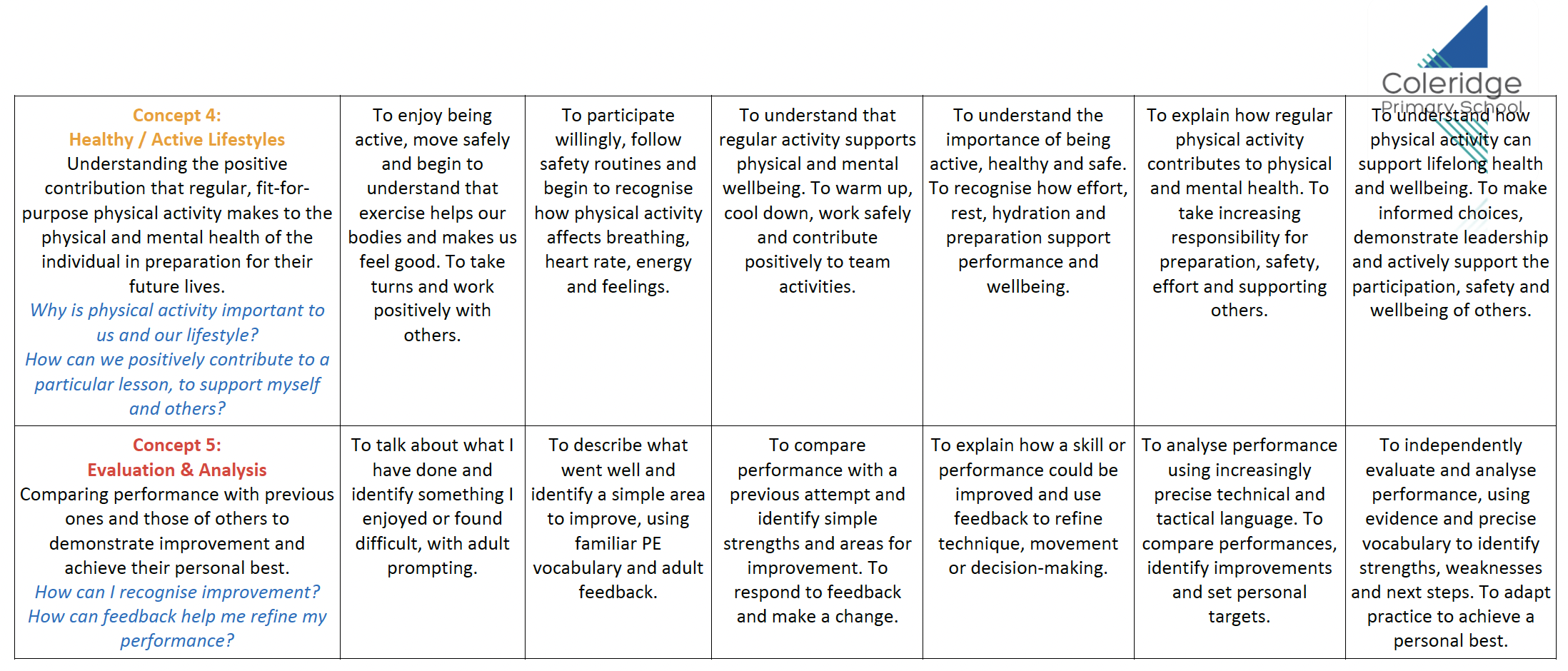
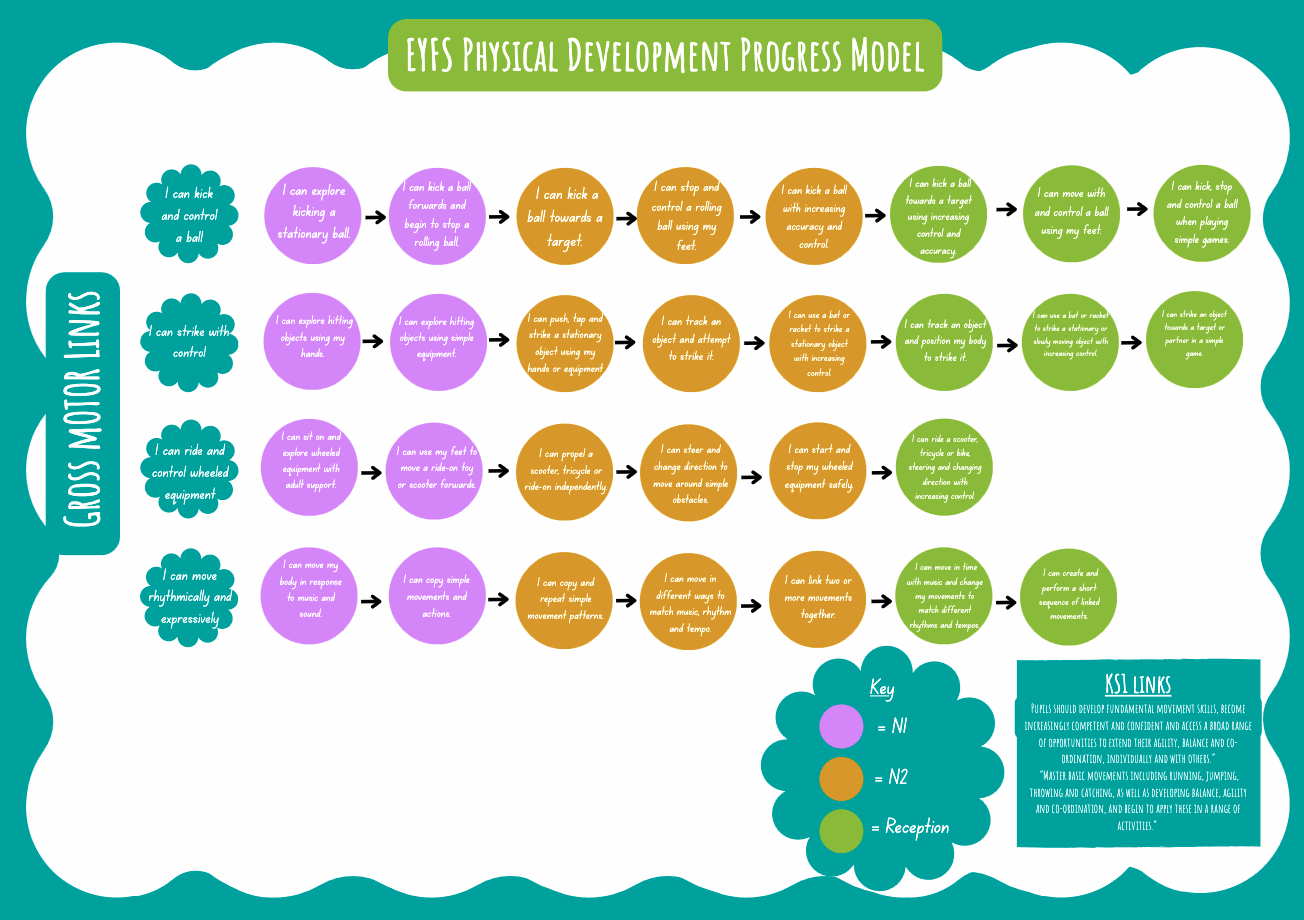
At Coleridge, we use carefully planned progress models to ensure that children develop physical skills, knowledge and confidence in a structured and age-appropriate way. Physical development in the Foundation Stage is carefully planned to promote children’s gross motor skills, fine motor skills, self-care and independence. Through a range of purposeful activities and play-based experiences, children develop the fundamental movement, coordination and personal skills needed for successful learning. This strong foundation ensures that pupils are ready to progress into Key Stage 1 and Key Stage 2, where they can build upon these early skills and develop increasing competence, confidence and enjoyment across all areas of Physical Education. Our progression models ensure that learning is sequenced effectively, enabling children to revisit, refine and master skills as they move through the school.




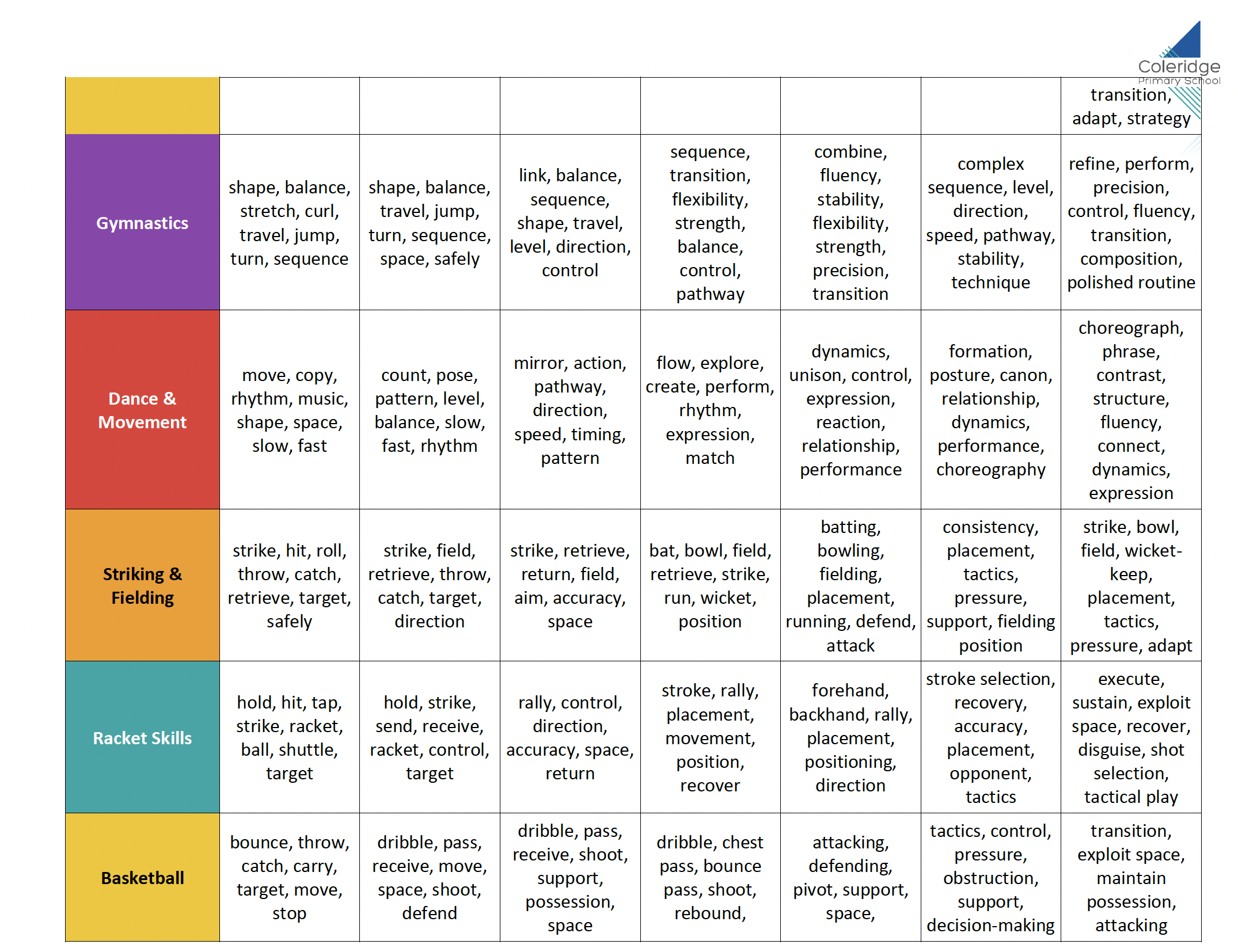
Progression of Language


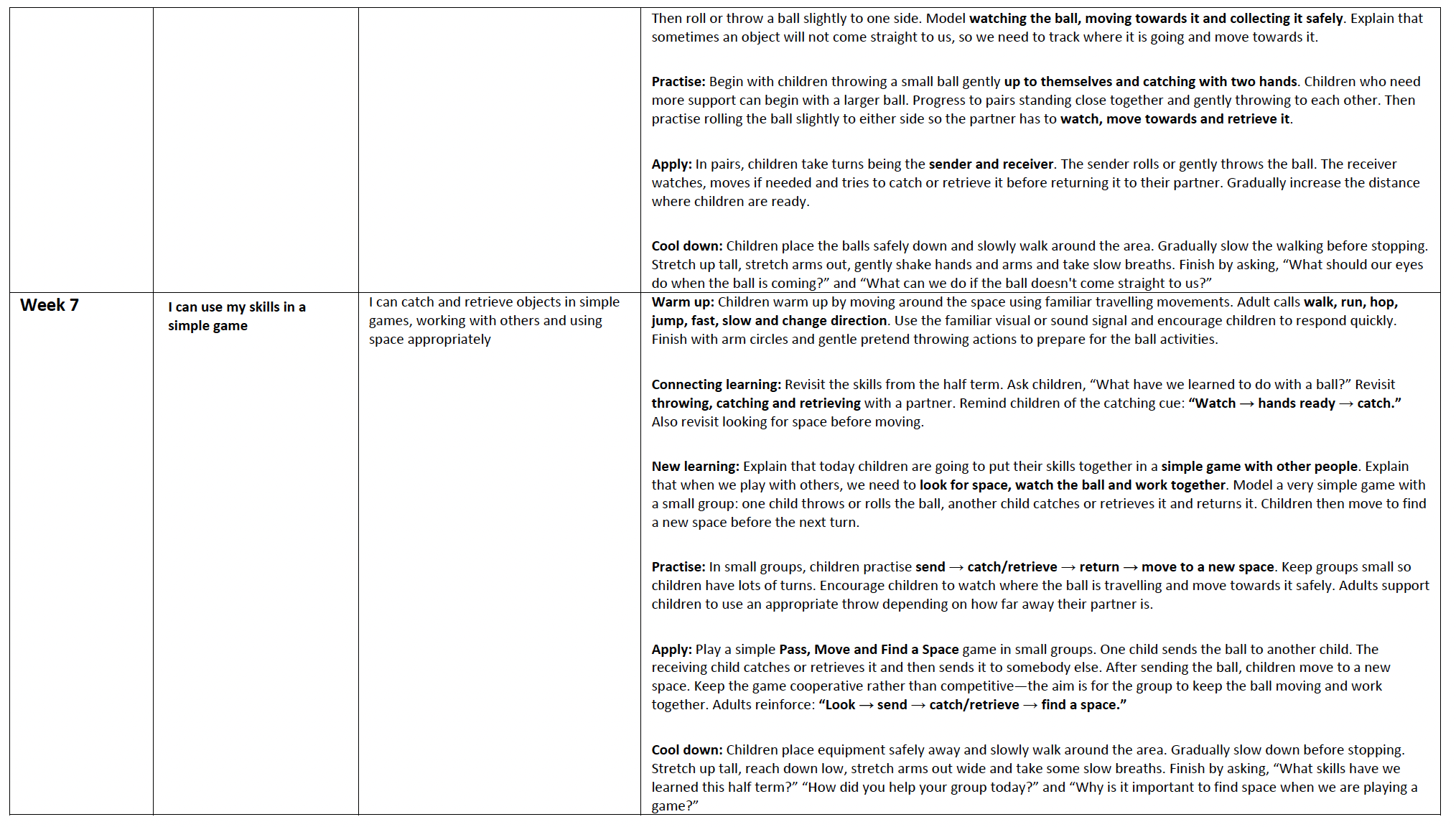
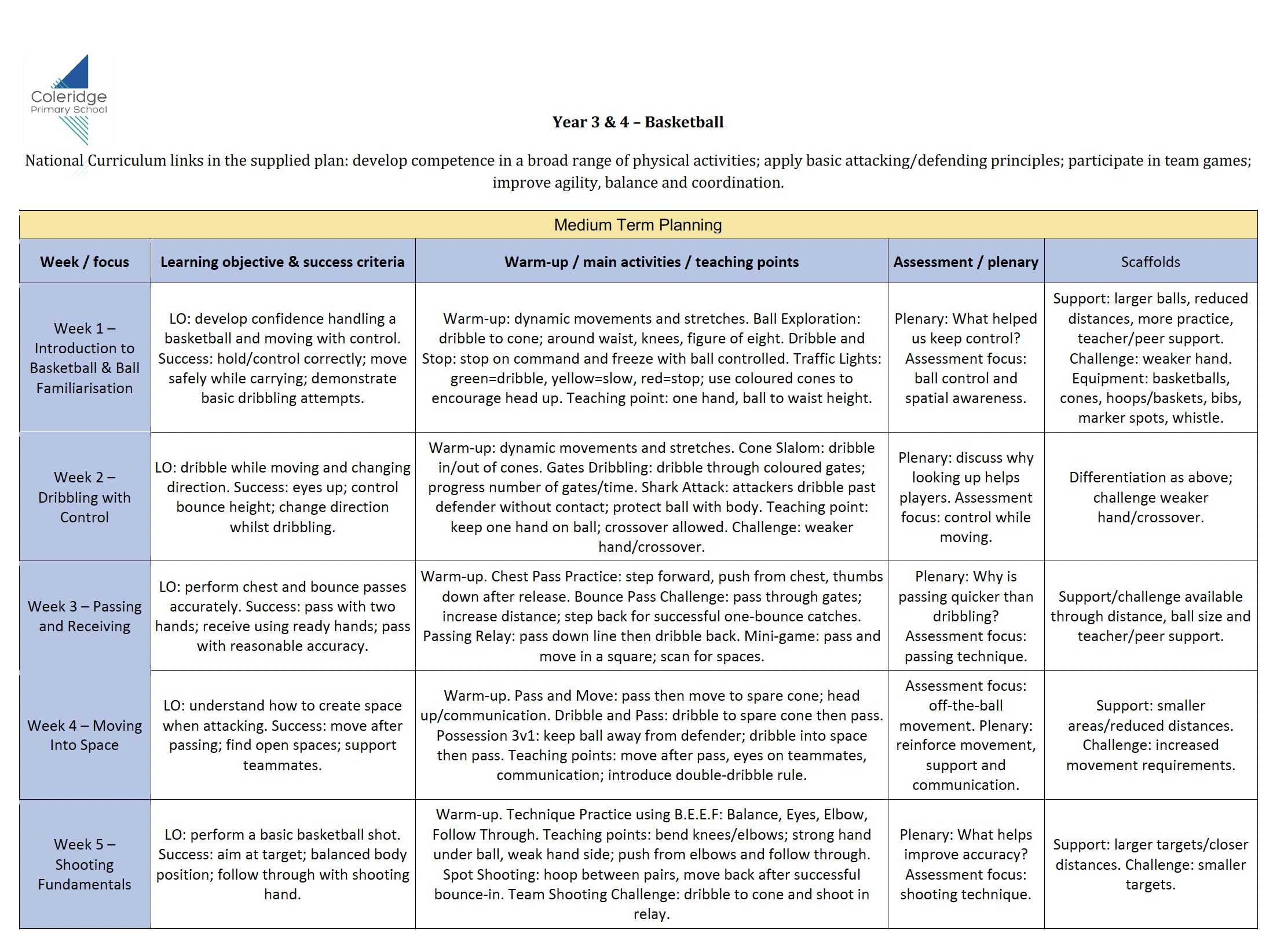
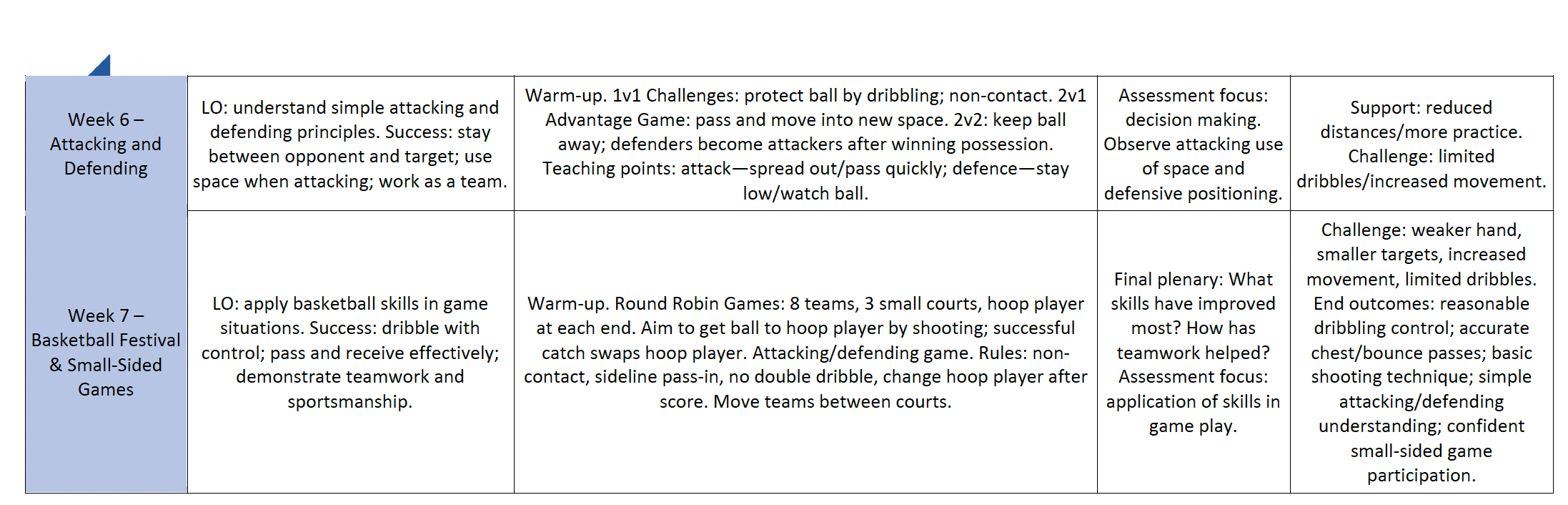
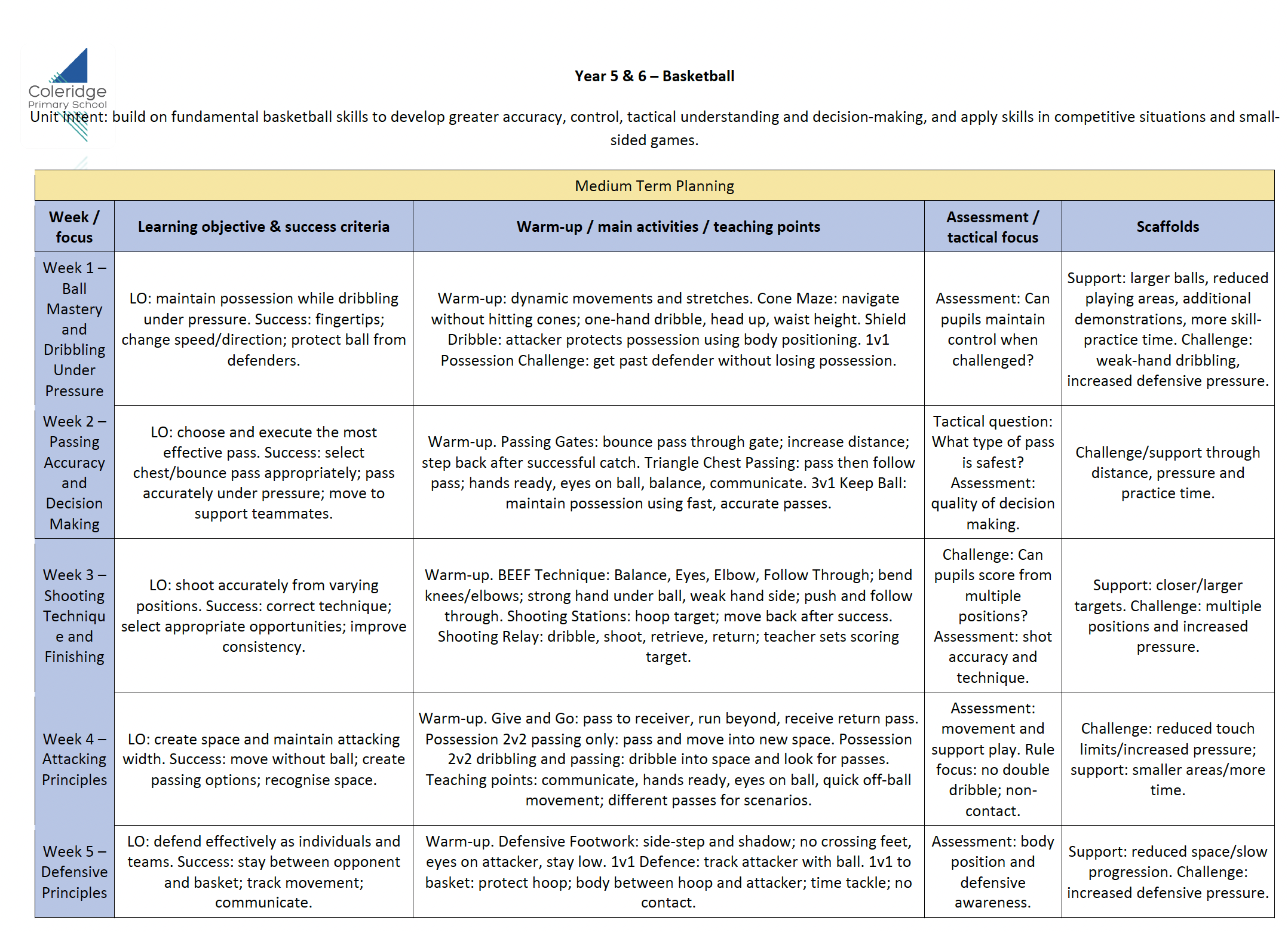
Medium Term Planning
Reception – Let’s Move
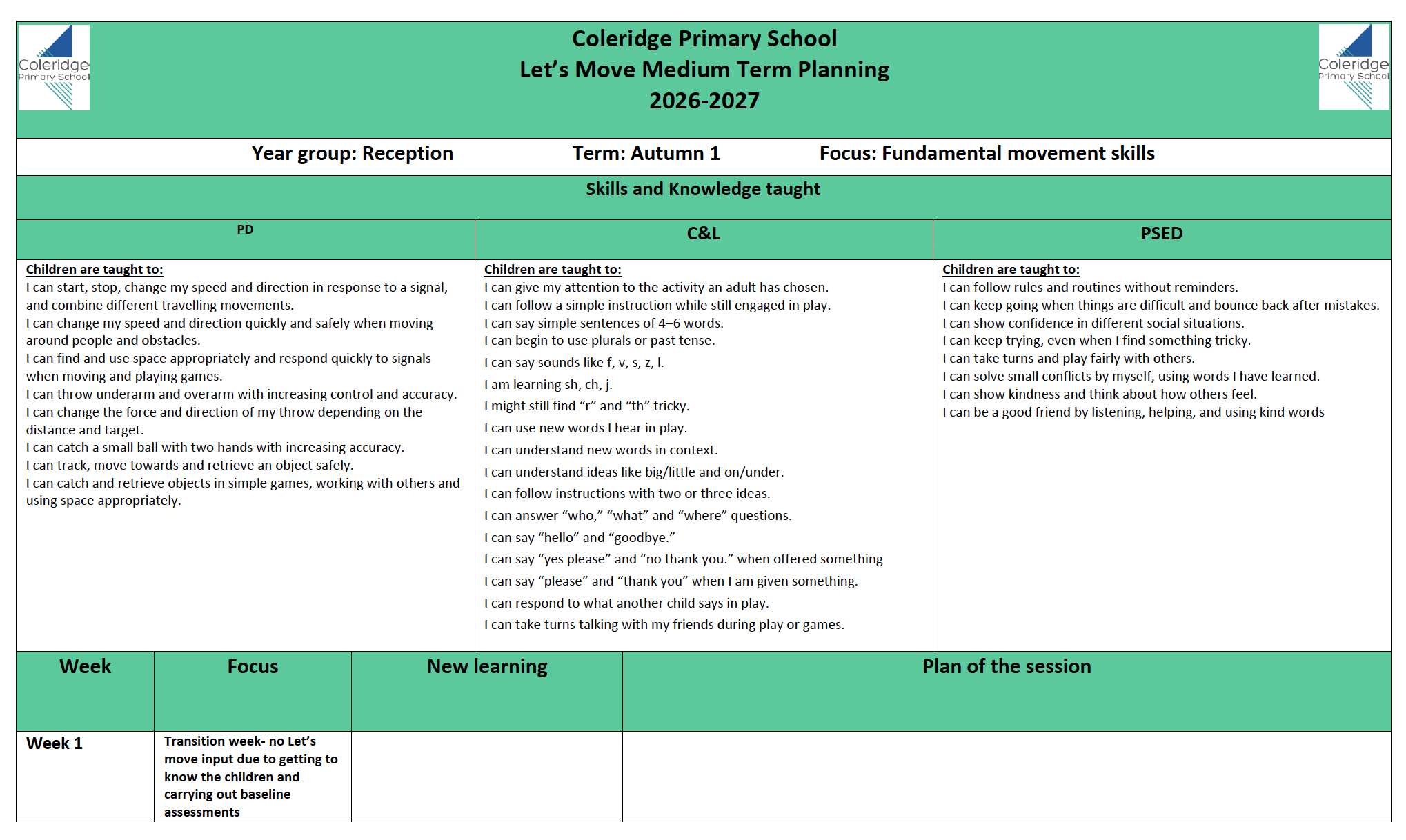
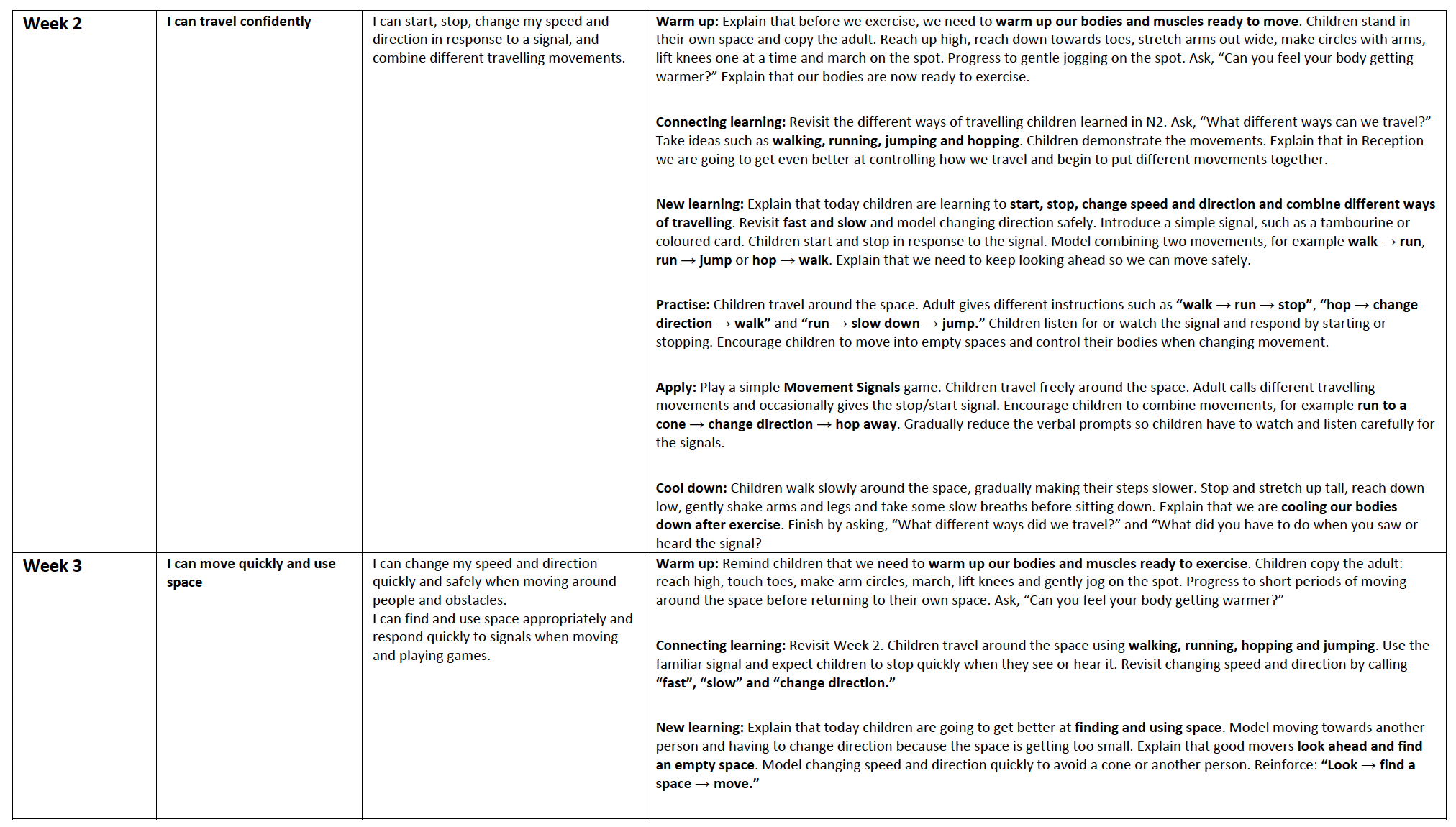
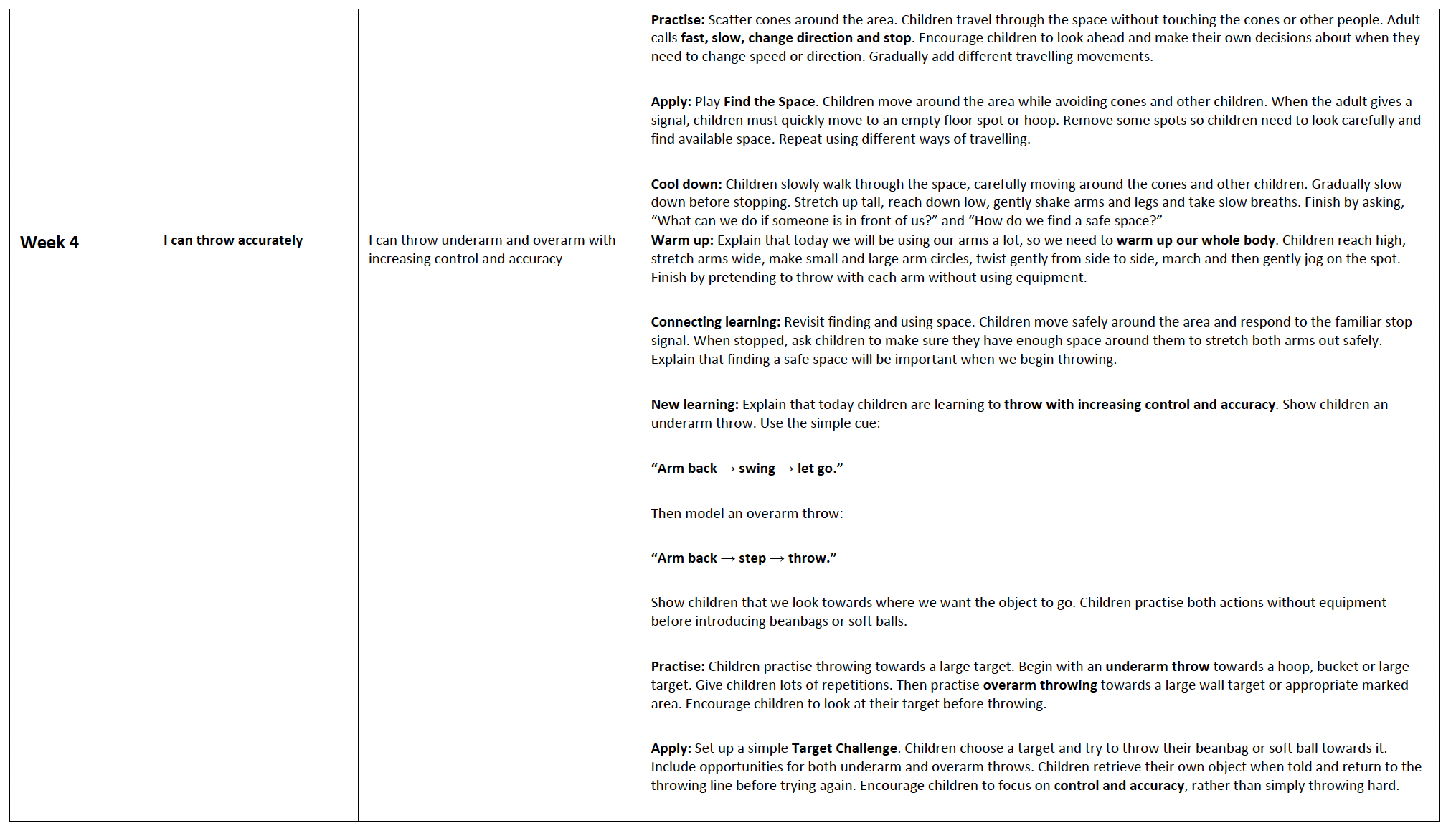
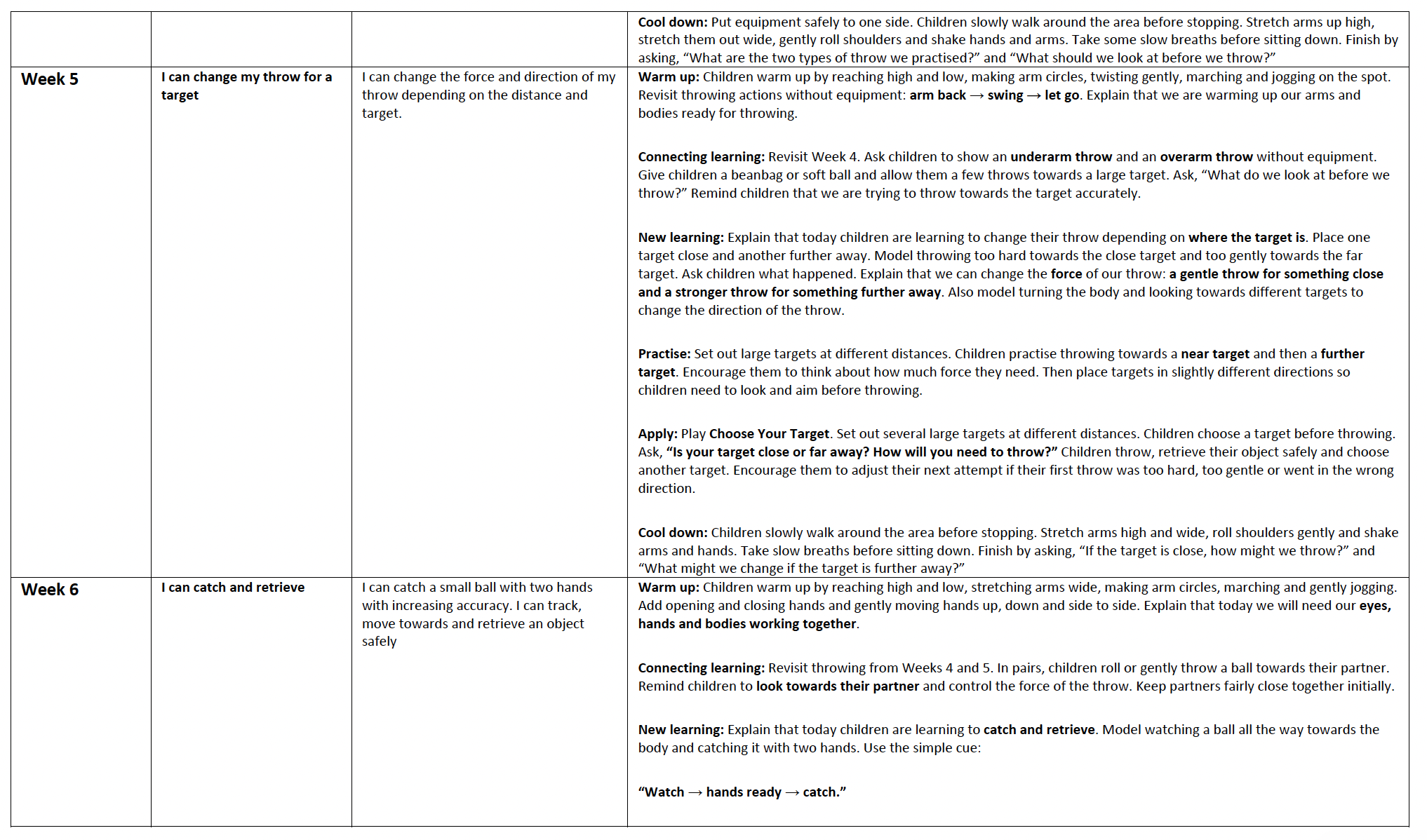
Year 3 & 4 – Basketball
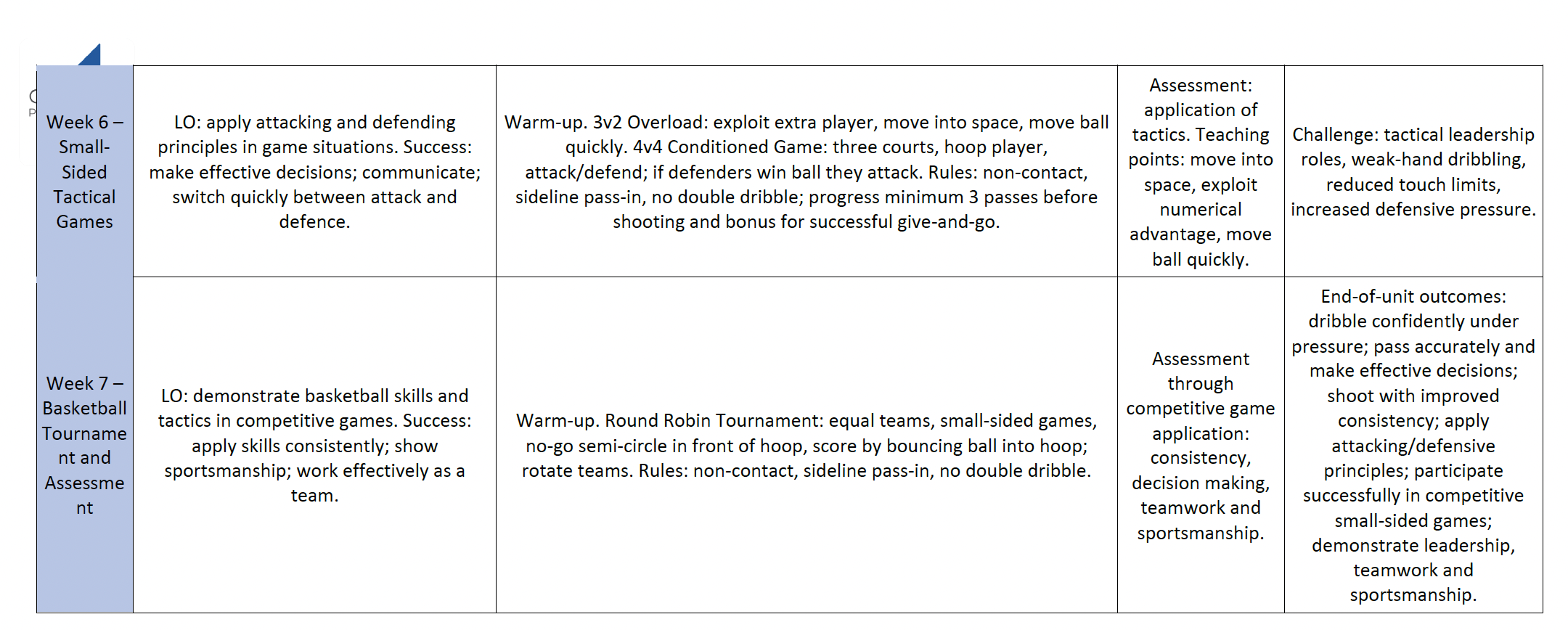
Year 5 & 6 – Basketball
Policies
End Points
| Subject – End Points | |||||||
| Reception | Year 1 | Year 2 | Year 3 | Year 4 | Year 5 | Year 6 | |
| Autumn 1 | Ball skills: Throw and catch a range of large and small balls with increasing control, using two hands and beginning to aim towards a target. | Passing and receiving: Develop accurate rolling, throwing and catching, moving towards the ball and finding space to receive. | Passing and receiving: Master passing and receiving with control, moving into space and beginning to make simple decisions about when and where to pass. | Basketball: Develop controlled passing, receiving and dribbling, using space and combining skills in modified games. | Basketball: Pass, receive and dribble with increasing control, create space and begin to apply attacking and defensive tactics. | Basketball: Combine passing, receiving and dribbling effectively, use space intelligently and apply attacking and defensive strategies in competitive games. | Basketball: Apply passing, receiving, dribbling and shooting skills confidently in competitive games, making tactical decisions when attacking and defending. |
| Autumn 2 | Ball skills: Develop coordination through rolling, bouncing, carrying and controlling a ball, responding to simple instructions and space. | Matball: Use passing, receiving and movement skills to keep possession, find space and work cooperatively within a simple game. | Matball: Apply passing, receiving, movement and simple attacking/defending skills, following rules and making basic decisions in a modified game. | Handball: Develop passing, receiving, dribbling and shooting skills, using space and movement in modified games. | Handball: Combine passing, receiving, dribbling and shooting with effective movement and simple attacking and defensive tactics. | Handball: Use running, passing, receiving and shooting with increasing accuracy, selecting appropriate tactics in competitive games. | Handball: Combine passing, movement, dribbling and shooting effectively, creating and defending space and adapting tactics during competitive play. |
| Spring 1 | Gymnastics: Explore and create short sequences using different shapes, balances, travelling actions and changes of direction. | Gymnastics: Perform basic sequences safely, using balances, travelling, jumps and changes of direction with control. | Gymnastics: Link balances, travelling and jumps into sequences, using a range of body shapes and showing increasing control. | Gymnastics: Create and perform linked sequences, showing flexibility, strength, balance, control and safe use of space and equipment. | Gymnastics: Combine movements, balances and actions on equipment to create a fluent routine individually and collaboratively. | Gymnastics: Create increasingly complex sequences with changes of direction, levels, speed and pathways, demonstrating stability, flexibility, strength and control. | Gymnastics: Plan, perform and refine polished sequences using a wide range of movements, balances and transitions with precision, control and creativity. |
| Spring 2 | Dance and movement: Move in time to music, explore different levels, directions and speeds, and create simple movement patterns. | Striking and fielding: Develop basic striking and fielding skills, using equipment safely and beginning to direct a ball into space. | Striking and fielding: Strike, retrieve and return a ball with increasing control, beginning to choose where to hit and where to field. | Cricket: Develop batting, bowling and fielding skills, applying them in simple game situations and understanding basic roles. | Cricket: Combine batting, bowling and fielding skills, making simple tactical decisions about placement, running and defending space. | Cricket: Bat, bowl and field with increasing consistency, selecting appropriate tactics and working effectively as part of a team. | Cricket: Apply batting, bowling, fielding and wicket-keeping skills confidently in competitive games, adapting tactics to game situations. |
| Summer 1 | Striking and racket skills: Explore striking objects with hands and a range of rackets, developing coordination, control and direction. | Racket skills: Develop basic racket control, sending and receiving with increasing accuracy and beginning to sustain a short rally. | Racket skills: Control the racket and shuttle/ball with greater consistency, sustain rallies and begin to use space deliberately. | Racket skills: Develop a range of strokes, improve placement and movement, and sustain rallies with increasing control. | Racket skills: Combine different strokes with movement and positioning, controlling direction and placement during rallies. | Racket skills: Use a range of strokes with accuracy, recover to position and apply simple tactics to outmanoeuvre an opponent. | Racket skills: Select and execute appropriate strokes, sustain rallies under pressure, exploit space and apply effective tactics in competitive play. |
| Summer 2 | Athletics: Demonstrate developing strength, balance and coordination through running, jumping and throwing activities. | Athletics: Develop running, jumping and throwing actions with improving coordination, balance and control. | Athletics: Master basic running, jumping and throwing techniques, aiming to improve speed, distance and accuracy. | Athletics: Perform running, jumping and throwing techniques with increasing efficiency, applying them to improve personal performance. | Athletics: Refine technique in running, jumping and throwing, using pace, power and coordination to improve performance. | Athletics: Apply effective running, jumping and throwing techniques, selecting appropriate strategies to improve speed, distance and accuracy. | Athletics: Perform running, jumping and throwing events with technical control, applying pace, power and tactics to maximise personal performance. |
How Parents/Carers Can Help
You can help your child by developing an interest in sports, physical activity and by encouraging your child to think about a healthy lifestyle. PE and physical activity have a huge impact on physical and mental health, and this should also be encouraged at home. Although children joining sports clubs is brilliant, children should also be encouraging to form a positive relationship with physical activity that they enjoy.
The government recommends that children have an hour of activity a day: 30 minutes in school and 30 minutes out of school. This means that being active out of school, such as how children travel to school, can make a huge impact.
Useful Websites
Useful Websites
- Rotherham United Community Sports Trust
- The Body Coach – YouTube
- Cosmic Kids – YouTube
- BBC Super Movers
- BBC Teach
- Get Set 4 P.E
- Go Noodle – YouTube
- Youth Sport Trust
- Jump Start Jonny
- Jack Hartman
- Active Kids
- Yoga with Adriene – YouTube
- KIDZ BOP – YouTube
- The Ballet Coach
- Twinkl Move
- Just Dance – YouTube
- Nuffield Health – YouTube
- NHS Change 4 Life
- Premier League Primary Stars