
Maths

Aims
Maths – National Curriculum Aims
Purpose of study
Mathematics is a creative and highly inter-connected discipline that has been developed over centuries, providing the solution to some of history’s most intriguing problems. It is essential to everyday life, critical to science, technology and engineering, and necessary for financial literacy and most forms of employment. A high-quality mathematics education therefore provides a foundation for understanding the world, the ability to reason mathematically, an appreciation of the beauty and power of mathematics, and a sense of enjoyment and curiosity about the subject.
Aims
The national curriculum for mathematics aims to ensure that all pupils:
- become fluent in the fundamentals of mathematics, including through varied and frequent practice with increasingly complex problems over time, so that pupils develop conceptual understanding and the ability to recall and apply knowledge rapidly and accurately.
- reason mathematically by following a line of enquiry, conjecturing relationships and generalisations, and developing an argument, justification or proof using mathematical language
- can solve problems by applying their mathematics to a variety of routine and nonroutine problems with increasing sophistication, including breaking down problems into a series of simpler steps and persevering in seeking solutions.
Mathematics is an interconnected subject in which pupils need to be able to move fluently between representations of mathematical ideas. The programmes of study are, by necessity, organised into apparently distinct domains, but pupils should make rich connections across mathematical ideas to develop fluency, mathematical reasoning and competence in solving increasingly sophisticated problems. They should also apply their mathematical knowledge to science and other subjects.
The expectation is that the majority of pupils will move through the programmes of study at broadly the same pace. However, decisions about when to progress should always be based on the security of pupils’ understanding and their readiness to progress to the next stage. Pupils who grasp concepts rapidly should be challenged through being offered rich and sophisticated problems before any acceleration through new content. Those who are not sufficiently fluent with earlier material should consolidate their understanding, including through additional practice, before moving on.
Information and communication technology (ICT)
Calculators should not be used as a substitute for good written and mental arithmetic. They should therefore only be introduced near the end of key stage 2 to support pupils’ conceptual understanding and exploration of more complex number problems, if written and mental arithmetic are secure. In both primary and secondary schools, teachers should use their judgement about when ICT tools should be used.
Spoken Language
The national curriculum for mathematics reflects the importance of spoken language in pupils’ development across the whole curriculum – cognitively, socially and linguistically. The quality and variety of language that pupils hear and speak are key factors in developing their mathematical vocabulary and presenting a mathematical justification, argument or proof. They must be assisted in making their thinking clear to themselves as well as others and teachers should ensure that pupils build secure foundations by using discussion to probe and remedy their misconceptions.
School Curriculum
The programmes of study for mathematics are set out year-by-year for key stages 1 and 2. Schools are, however, only required to teach the relevant programme of study by the end of the key stage. Within each key stage, schools therefore have the flexibility to introduce content earlier or later than set out in the programme of study. In addition, schools can introduce key stage content during an earlier key stage, if appropriate. All schools are also required to set out their school curriculum for mathematics on a year-by-year basis and make this information available online.
Attainment Targets
By the end of each key stage, pupils are expected to know, apply and understand the matters, skills and processes specified in the relevant programme of study.
Intent, Implementation and Impact
Intent
At Coleridge Primary, we aim for every child to become fluent, confident and curious mathematicians. We ensure pupils:
- Secure strong number sense through Mastering Number
- Develop fluency, reasoning and problem-solving in every lesson
- Apply maths confidently across a range of contexts
- Build a positive mindset and enjoyment of maths through challenge, exploration and talk
- Gain the foundational knowledge needed for progression year on year
We are committed to equity and inclusion. All children are expected to achieve well and experience success in mathematics, including those who are disadvantaged or have SEND.
Implementation
Our approach is informed by the NCETM spine materials, Ready to Progress criteria and DfE prioritisation curriculum. Planning is sequential and cumulative, and formative and summative assessments are used continuously to ensure rapid progress.
Key features of implementation:
- Whole-class teaching with high expectations for all learners
- Daily Mastering Number for number sense and fluency
- Retrieval practice embedded to secure foundational knowledge
- Bespoke times tables provision, informed by research, ensuring rapid recall (reflected in strong MTC outcomes)
- Manipulatives, scaffolds and representations used to support and deepen understanding
- Problem solving and reasoning threaded through all units to challenge every learner
- Immediate and short-term intervention delivered to keep pupils on track
- Mathematical talk promoted through stem sentences, precise vocabulary and partner discussion
Teachers use assessment and feedback continuously to shape learning, address misconceptions and adapt provision.
Impact
As a result of this approach:
- Pupils have secure mathematical foundations and make strong progress from their starting points
- Gaps are identified early and addressed through pre/post assessments and timely intervention
- Children increasingly demonstrate fluency, flexibility and confidence
- Reasoning and problem-solving skills are evident in pupil work and discussion
- Pupils talk positively about maths and show resilience and curiosity
- Children are well prepared for the next stage of learning
Mathematics is a significant strength at Coleridge, with pupils consistently achieving outcomes well above national averages and those of similar schools. Over the last three years, 80% of pupils reached the expected standard in mathematics compared to 74% nationally, while 34% achieved the higher standard compared to 26% nationally. In 2026, outcomes were particularly strong, with 87% of pupils meeting the expected standard and 43% achieving the higher standard. The impact of the curriculum is especially evident for disadvantaged pupils, 85% of whom achieved the expected standard in 2026, substantially outperforming disadvantaged pupils nationally. These outcomes demonstrate the effectiveness of high-quality teaching, a well-sequenced and ambitious curriculum, and the school’s commitment to ensuring all pupils, regardless of background, achieve exceptionally well and are fully prepared for the next stage of their education.
Maths at Coleridge
At Coleridge Primary School, we aim to equip all pupils with the skills and confidence to solve a wide range of problems through fluency with numbers and secure mathematical reasoning.
Our journey to improve the teaching and learning of mathematics for every child began in September 2018. Since then, several key elements have influenced improvements in attainment and progress in mathematics across the school.
Mathematics is led by Mrs J. Shaw, Maths Lead and Primary Maths Specialist for the South Yorkshire Maths Hub, who also travelled to Shanghai in 2019 to further research and develop our understanding of the mastery approach.
This document outlines our approach to the teaching and learning of mathematics at Coleridge and explains the rationale behind it.
Mathematics lessons
Whole Class Together
At Coleridge, we teach mathematics to whole classes and do not label children. Lessons are planned using information gathered from pre-assessments, which identify children’s existing knowledge and understanding.
Teachers plan small-step learning sequences based on this information, ensuring that all children are supported to access the same key concept at an appropriate level of challenge.
- Scaffolds and foundational practice are provided for pupils who are not yet secure, enabling them to strengthen core knowledge and skills.
- Challenge tasks deepen understanding for those who grasp concepts quickly.
- Formative assessment within lessons, alongside post-assessments, identifies any gaps in understanding.
- Interventions are then planned and delivered promptly to ensure pupils ‘keep up with the curriculum’ rather than fall behind.
All teaching and learning in mathematics is underpinned by the NCETM spine materials, Ready to Progress criteria, and the DfE Prioritisation materials. These frameworks ensure carefully sequenced progression, coherence, and consistency across all year groups. Teachers plan lessons in small, progressive steps that develop deep understanding and secure fluency in number and calculation.
Longer but Deeper
To ensure pupils develop secure and deep understanding, we spend longer exploring key concepts in greater depth rather than covering content superficially. This approach means progress may appear slower, but it ensures greater retention and stronger connections across mathematical topics. Using the prioritisation curriculum, we ensure children are taught key foundational knowledge that will ensure they are ready to progress to the next year. Our approach to practice is not repetitive drill, but intelligent practice characterised by variation. Carefully chosen tasks help pupils apply concepts in multiple ways and deepen understanding.
Questioning
Teachers use precise mathematical language and probing questions to develop reasoning and understanding. Pupils are encouraged to respond in full sentences using sentence stems, talk frames and generalisations.
Common questions include:
How do you know? Can you prove it? Are you sure? Can you represent it another way? What’s the same and what’s different? Can you explain that? What does your partner think?
Rapid Intervention
New learning builds on prior understanding. To maintain whole-class progression, any misconceptions or difficulties are addressed immediately through same-day or next-morning intervention, ensuring pupils are ready for new learning.
Mastering Number
The Mastering Number programme is delivered from Reception to Year 6 and focuses on developing factual fluency and number sense – enabling pupils to understand and manipulate numbers flexibly and efficiently.
The programme:
- Builds a deep understanding of number relationships and composition.
- Develops automatic recall of key facts such as bonds within 10 and 20.
- Strengthens pupils’ confidence and accuracy when working with numbers.
This strong foundation supports later success in arithmetic, reasoning, and problem-solving.
Pupils identified as needing further support in their number fluency receive targeted interventions to ensure they secure these fundamental skills before progressing.
Multiplication Facts
From Year 3 onwards, pupils take part in daily times table sessions designed to ensure rapid and accurate recall of multiplication and division facts.
These sessions include:
- Rote learning and repetition to secure fluency.
- Daily testing and retrieval practice to strengthen memory and confidence.
- Intervention sessions for those who show gaps in knowledge, ensuring all children develop secure number fact fluency.
Quick recall of multiplication facts underpins much of the mathematics curriculum and is vital for success in upper Key Stage 2 and beyond.
At Coleridge, our approach to mathematics is built on the belief that all children can achieve. Through mastery teaching, small-step progression, rapid intervention, and daily rehearsal of key facts, we ensure every child develops fluency, reasoning, and problem-solving skills, preparing them for lifelong mathematical success.
Foundational Knowledge
Building Strong Mathematical Foundations at Coleridge Primary School
At Coleridge Primary School, we believe that success in mathematics begins with secure foundational knowledge. Foundational knowledge is the essential understanding, facts, skills and language that children need before they can successfully learn more complex mathematical concepts. Just as a house needs strong foundations before it can be built higher, children need secure mathematical foundations to become confident and successful mathematicians. Research shows that when children develop a deep understanding of fundamental mathematical concepts early, they are better able to make connections, reason mathematically and solve problems as they progress through school.
The Foundations of Mathematical Learning
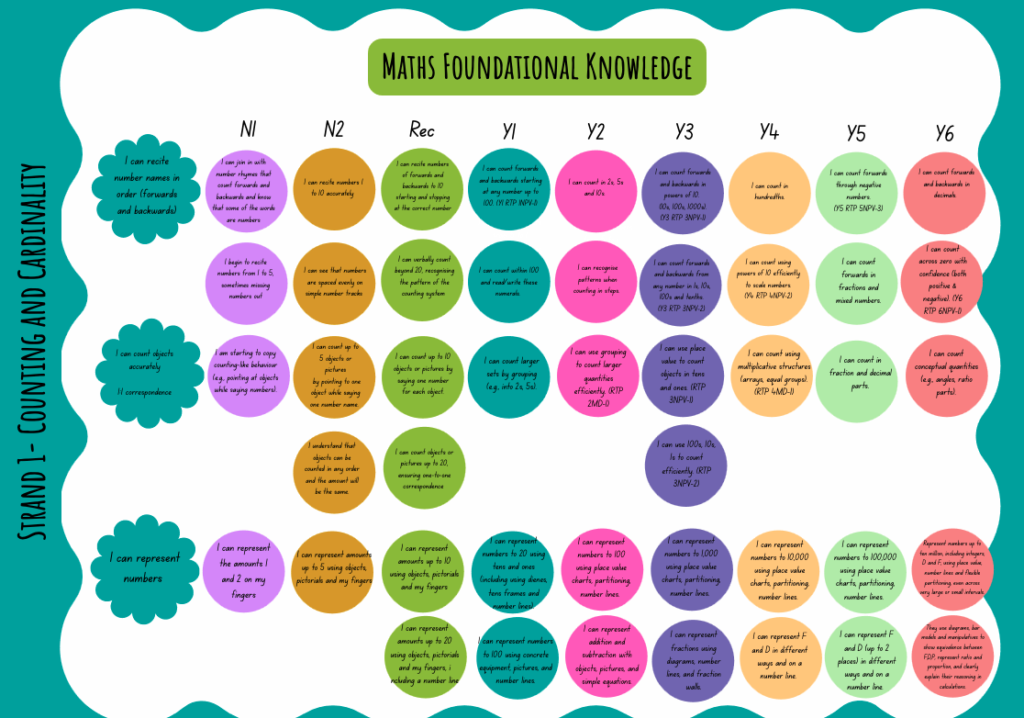
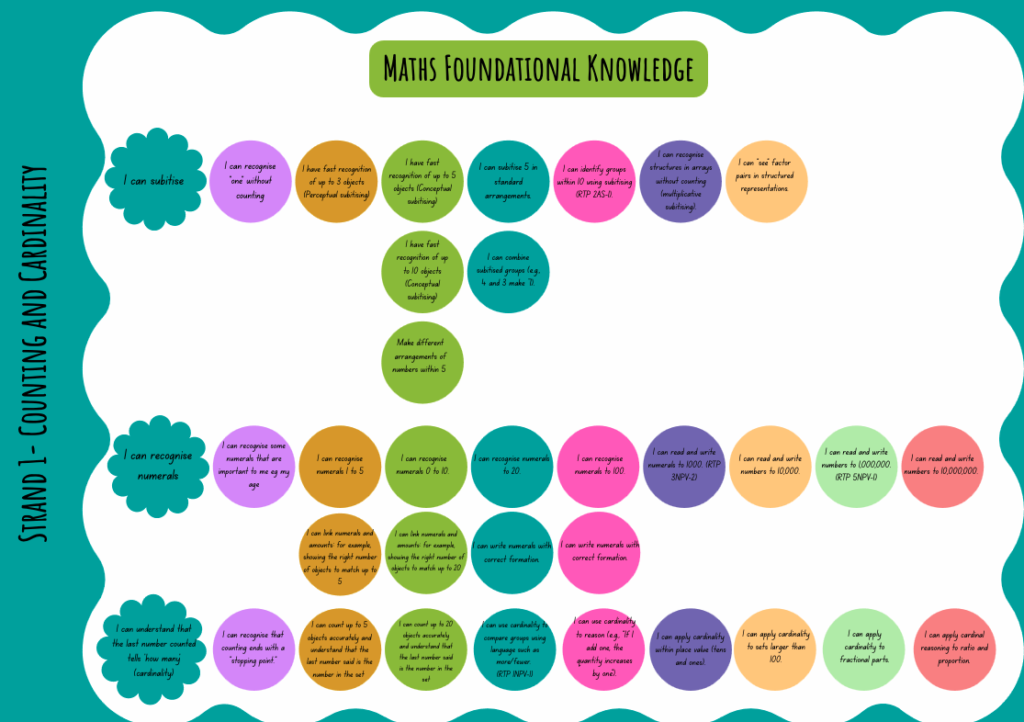
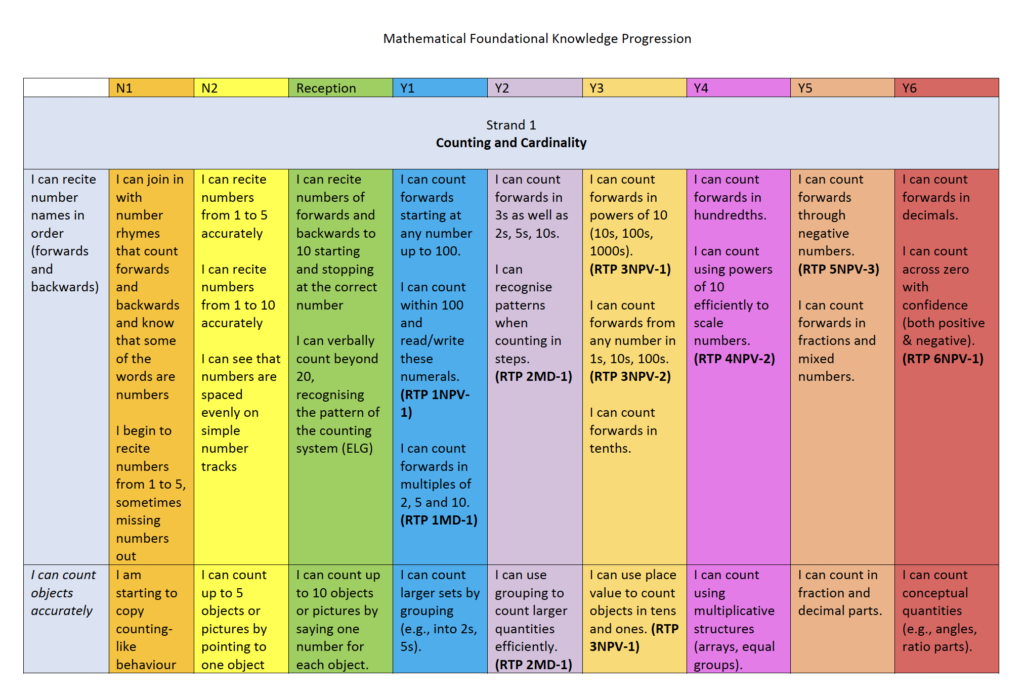
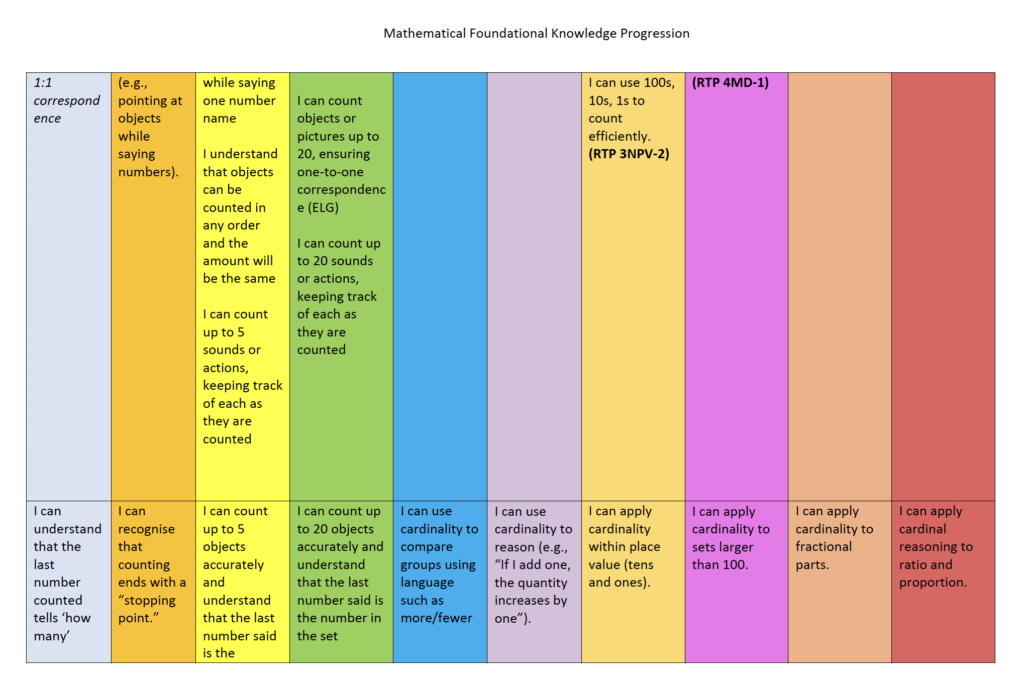
Our Foundational Knowledge Progression identifies the key mathematical concepts that develop from Nursery through to Year 6 and are rooted in the Early Years curriculum. We recognise that mathematical understanding develops over time through carefully sequenced learning and secure understanding of key concepts. Our progression focuses on developing strong number sense, counting and cardinality, comparison, composition, pattern, shape and spatial reasoning, and measure. By ensuring children develop fluency, recognise mathematical relationships and make connections between ideas, we help them build the strong foundations needed for future mathematical success.
Our Approach in the Classroom
We want all children to feel successful, included and engaged in mathematics lessons. Children needing support in a particular lesson begin learning alongside their peers and take part in whole-class teaching, discussion and reasoning activities. We believe that every child should have access to high-quality mathematical learning and opportunities to develop their understanding alongside their classmates. Teachers carefully adapt learning to ensure all children can succeed by identifying and securing the knowledge needed before new learning is introduced. Learning is broken down into small, manageable steps and supported through mathematical talk, sentence stems, concrete resources and visual representations. Where additional support is needed, children may take part in short bespoke activities that focus on the foundational knowledge required to access the current learning. Wherever possible, this support is linked directly to the year group objective being taught, enabling children to strengthen essential mathematical understanding while remaining connected to the wider curriculum.
Developing Fluency with Number Facts
At Coleridge Primary School, we recognise that fluent recall of key number facts is essential for success in mathematics. Through the NCETM Mastering Number programme, children develop a deep understanding of number and the relationships between numbers, rather than simply memorising facts. This helps children become more efficient, flexible and confident mathematicians. In Reception to Year 3, Mastering Number focuses on developing strong additive fluency and number sense. Children explore the relationships between numbers, secure number bonds, develop confidence with addition and subtraction facts, and build understanding through subitising, counting and recognising number patterns. This creates the firm foundations needed for future mathematical learning. From Years 4 to 6, the focus shifts towards developing conceptual understanding and fluency in multiplication and division. Children deepen their understanding of multiplicative relationships, times tables and division facts, enabling them to apply these efficiently and accurately when solving more complex mathematical problems. To ensure every child develops secure number fact knowledge, pupils from Years 1 to 6 are regularly assessed to identify gaps in fluency and understanding. Assessment information is used to provide timely interventions and targeted support, helping children strengthen key number facts and secure the mathematical foundations needed to access the wider curriculum. Through this approach, we aim for all children to develop confidence, flexibility and fluency with number.
Why This Matters
Our goal is not simply to help children complete today’s lesson. Our goal is to ensure that children develop the secure mathematical foundations they need for long-term success. Through our Foundational Knowledge approach, children develop:
- Confidence in mathematics.
- Strong number sense and fluency.
- Secure understanding of key concepts.
- Mathematical language and reasoning skills.
- Greater independence and resilience.
- Improved access to age-related expectations.
By systematically developing these foundations, we help every child build the knowledge, confidence and understanding needed to become successful mathematicians both now and in the future.
Foundational Knowledge
Foundational Knowledge Progression
Number Fact Progression
Multiplication Check
What is the MTC?
All Year 4 children in England take part in the Multiplication Tables Check (MTC) in the summer term (June) each year. The check is designed to see how well children can recall their times tables facts up to 12 × 12 — a key skill that supports confidence and success in maths as they move into Upper Key Stage 2 and beyond.
Why is the test important?
Knowing times tables by heart helps children with:
- More efficient problem-solving
- Faster and more accurate written and mental calculations
- Confidence when tackling new mathematical concepts
The test is not about catching children out — it simply helps teachers identify who might need a bit of extra support with their multiplication facts.
How the test works
- The check is completed online, using a computer or tablet.
- Children answer 25 questions on multiplication facts from the 2 to 12 times tables.
- Each question gives 6 seconds to answer, with a short pause before the next one.
- The test takes no more than 5 minutes to complete.
- Questions are randomly selected, focusing on the 6, 7, 8, 9 and 12 times tables.
- Results are shared with schools (not published nationally or compared publicly).
- Children complete practice sessions in school beforehand so they know what to expect.
How we prepare children at school
Throughout Key Stage 2, children take part in daily times tables sessions to build fluency and confidence. We also use TT Rock Stars and other engaging activities to make practice fun and meaningful. Teachers monitor progress closely and provide support where needed so that every child feels prepared and confident by the time of the check.
How you can help at home
- 🎵 Sing or chant times tables to music or rhythm.
- 🎮 Use TT Rock Stars or other online games for fun practice.
- 🧱 Build arrays with Lego, coins or counters to show multiplication patterns.
- 🔄 Mix up the questions (e.g. “What’s 8 × 7? What’s 12 × 6?”) to build recall.
- 📚 Use practice books or quiz cards to review facts together.
In summary
The Year 4 Multiplication Tables Check is a quick, low-pressure way for teachers to see how well children know their multiplication facts. With regular practice at school and at home, children can approach it with confidence — and build strong mathematical foundations for the future.
Times Table Rock Stars


Calculation
Number and Place Value
Multiplication and Division
Fractions
Addition and Subtraction
Teacher Exchange
Jessica Shaw – China Exchange November 2019
At the beginning of November, after being selected as part of the DFE’s England-China exchange, I spent two weeks in Shanghai analysing and experiencing mathematics teaching at first hand. I was given the opportunity to spend time in two schools. A local Shanghai school which used government implemented text-books and scheme of work and an international which had devised its own textbooks around the accelerated progress of their children. We were welcomed into both schools and were immersed in their culture of learning and their continuous use of TRG discussions to analyse and improve the teaching of mathematics. This is a culture of learning and open door classrooms which has been developed over the last 10 years and is by no means a quick fix to rapidly improve the teaching of mathematics in the UK. I will discuss below some of the findings which were pertinent over the two weeks I spent in Shanghai.
Textbooks
All local schools in Shanghai follow the government implemented Shanghai textbooks which is given to teachers alongside ppts and a teacher guide. Children are given a practice book and text book which teachers use in most lessons. Because these lessons are so carefully structured, teachers are able to use these as a basis for their lesson and develop further challenge or support as is appropriate for their class. During our observations, many teachers would add real-life contexts and more complex problems to challenge their children. These textbooks always start at a low starting point and build to much more demanding content. One key concept is always introduced and maintained within each lesson so that teachers are not pressured to include too much: meaning children can concentrate on one key focus. There is a clear progression of skills throughout the textbooks so that teachers know exactly what has been taught before and where the learning is being taken. Because the same textbooks and ppts are used continuously over time, these lessons are stored and annotated and developed by each teacher so that they can be analysed and improved over time. I found it surprising that many teachers, who were part of the exchange, commented on identical lessons to the ones we had observed with small alterations or additions. We commented that going from school to school in the UK you may see a completely different topic or scheme of work in place and new lessons being created each year. Perhaps this is something to consider in creating a cohesive and progressive curriculum for the children in our communities.


TRG and lesson anaylsis
Throughout our specialist training, we have been coached and have facilitated TRG lesson analysis of which I can see the huge benefits for a more open and analytical study of lesson design around mathematics. However, to see this first hand showed me how a culture of shared learning and open-door policy can really vastly improve the teaching of mathematics. The Chinese teachers were so used to being observed and even filmed, that in one observation with 50 students there was 30 observers – some of whom were even hanging in the window, that they were not perturbed by this as they are continuously using the observations as a way to continuously design and improve lessons over time. After each lesson, a discussion was had around the session, where the teacher described the lesson focus; any potential misconceptions; the teaching process and any additions and alterations they had made with their reasoning behind their choices. After this analysis, each observer would comment on something they had noticed about the mathematics within the session. Because these teachers will often watch the same lesson multiple times over their years in the profession, they are continuously ensuring that they are learning from one another and that their lessons are improved by a shared discussion of children’s learning and the improvements on lesson design. In one seminar, we took part in a lesson which looked at the use of the number line using fractions. In this study, two planning sessions took place, the lesson was taught twice and then the lesson was analysed and reviewed. This shows the real dedication to improvements of key structures and models that will support the children in their understanding of mathematics.


Lesson length
Each lesson was precisely timed to 38 minutes and this was stuck to with rigour. Each lesson would end and start with music and would begin with the Chinese ‘eye exercises.’ This happens in all schools and children are focused and ready to learn at the beginning of each session. The lesson progress quickly from a low starting point to very challenging content. Chinese maths teacher in primary only teach this subject and teach around 2-4 lessons per day. After this session, children are asked to complete independent work and homework in order to consolidate the learning done in class. Therefore, when the teachers are not in class they are marking books, adapting planning or observing as part of a TRG.
Lesson structure
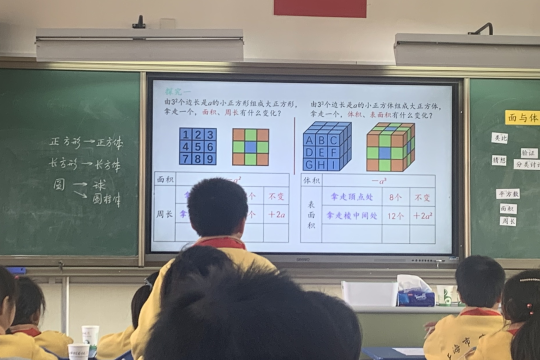
Observations showed that all lessons began with a key lesson focus. Often lessons would begin with a real-life focus, especially in KS1, to ensure that children were engaged and that purpose was given to their learning. Most lessons involved a practical group activity which included rich mathematical talk. This was something I didn’t expect to see and was surprised how active and fast paced the sessions were. Children were asked to share their ideas by standing up and sharing it with the class if they were chosen after their hand was raised. The teachers always knew the answers they wanted and instead of praising answers that were incorrect they would move onto someone with the correct answer. This is something which is rather different in English schools and an interesting point to consider. Do we over-praise children when they give an answer which irrelevant or incorrect? Often key learning points and generalisations would be placed on the right-side of the board. These would be repeated by a child, then to their partner and then as a whole class. Any equations or jottings would be placed on the left of the board. At the end of each session, children would be asked what t had learnt and would use these generalisations to summarise what they had learnt. Most lessons included a reasoning question to consolidate and challenge learners and these would come in the form of true or false and multiple choice questioning. The visualiser was used in all lessons and was so important in children being able to share their ideas and for the teachers to address any misconceptions; it was also a great tool to show a variety of possibilities in problem solving.



Number sense
Something that really struck me during my time in Shanghai was the quick recall of number facts throughout our observations. Children were never held back by their ability to calculate mentally which meant that as the content became harder they were able to handle it with ease. The below table shows how Chinese children learn their multiplication facts. When I asked the maths lead why children knew their multiplication facts so well, he noted that often children start school and have already learnt these facts. Chinese children understand commutativity and number facts in such a deep way that they only need to learn 45 facts to know their tables instead of our 144 facts. The language is also much easier for them to learn. Instead of saying, ‘one times one is one’ the children will simply say ‘one, one, one.’ In Chinese, 22 (twenty-two) is said, ‘two tens and two,’ meaning place value is something that is far easier for the children to understand. In geometry, quadrilaterals are called quadrangles meaning children can more easily link them with triangles and their properties.

Although a culture of learning and the importance of education it clearly instilled into the people China, this should not be something that deters us from learning from the Shanghai teachers and their teaching of mathematics. The continuous analysis and development of mathematics that has taken place over the past 10 years is something that should be admired and I feel very privileged to have witnessed this first-hand. I know that the importance of number sense and our children’s knowledge of key facts should be paramount in ensuring that children can develop their understanding of mathematics. The culture of learning from one another and sharing best practices to analyse and carefully craft lessons is so important in moving the teaching of mathematics forward. Finally, small steps are so important to ensure all children are kept together, but this must build to a challenging point where children are able apply their knowledge to different real-life contexts. Their carefully crafted lesson design and the children’s secure understanding of key facts means that the children of China are receiving an in depth understanding from the teaching of mathematics.